




Maine Black Bears | Yankee Classic
For three years Roy Hugie had monitored Maine black bears. His is the most extensive bear study ever carried on in New England, one of the most extensive, for that matter, in the country.

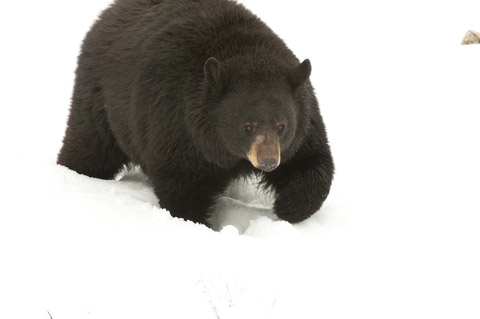
This Yankee Magazine Classic is from December 1978
Also, read a photographer’s account of his 2007 excursion to track Maine black bears.
There can be no talking now. The hearing acuity of Maine black bears mandates silence. Somewhere in this spruce forest in northern Maine dens a three-year-old black bear. He wears a collar equipped with a powerful radio transmitter that betrays his den site. Roy Hugie, listening to a pulsing loud and clear in the earphones clamped to his ears, knows the bear is near.
Hugie is a 32-year-old big game research biologist with the Maine Fish and Wildlife Department. For three years he has monitored Maine black bears. His is the most extensive bear study ever carried on in New England, one of the most extensive, for that matter, in the country. There are 17 black bears denning this winter wearing three-pound collars that will tell Hugie where, when, and possibly why they den where they do. In addition, another 200 bears roam the forests with ear tags firmly in place. Data on their ages (determined by tooth samples), weights, habitat preferences, home range areas, and ability to avoid hunters fill the files in Hugie’s office.
Each day Hugie says he learns something new about bears, which he calls “one of our most misunderstood and maligned animals.” Each day the mysteries soften a little. New questions arise, replacing ones just answered. Each day his respect for the Maine black bear grows. The more he learns about bears the more he frets about man.
“With habitat loss and overhunting you can be out of business with bears four years before you know what’s happened,” Hugie says. “The margin of error with bears is very small. Their reproductive rate is small. If we guess wrong the bear could be beyond recovery very soon in most places.”
There are more black bears in Maine (about 8500) than anywhere east of the Mississippi. The decline of the bear elsewhere has brought hunters to Maine in ever-increasing numbers. Each year there are more black bears killed in Maine, from 740 in 1974 to 1008 in 1976. It is Hugie’s belief that any further increase, coupled with the inevitability of shrinking habitat, will mean that the black bear is in serious trouble. But he needs facts to back him up. The sources of those facts he seeks now lie hidden in their forests, sleeping fitfully until May.
Roy Hugie has trekked for hours to reach a bear’s den. He wheels around in a small clearing. He paces quickly in a broad circle looking for signs he has come to trust. He relaxes and smiles, for the first time in a long while. He flings the earphones on the branch of a tree and jams the receiving antenna firmly in the snow. “There,” he says softly, and points to a tall white pine. At its base is a cavity where an immense root has been forced upwards. It is covered with snow. Only by straining can you see the faint trickle of steam vaporizing into the clear, cold day — the breath of a black bear.
Early New England Indians searched for the thin wisps of breath on icy days. If found on high, they cut down the tree. Flaming birch bark thrust into root cavities brought a bear with stinging eyes into the startling light and the spearpoint. Some hunters crawled into dens and clubbed the bear to death before it could rouse. Later, man regarded bears as vermin, like rats. Until 1957 in Maine, a hunter lucky or clever enough to find a denned sow with cubs could shoot the mother and cubs while they huddled together, deliver the snouts to Fish and Wildlife and collect $15 per snout.
Hugie crawls quietly to the mouth of the den and scoops the snow away. A 50-pound nylon net is secured to branches and packed with snow to form a canopy around the den. A syringe of ketamine hydrochloride is prepared and attached to the end of a three-foot-long jab stick. Hugie peers in and stares at the face of the bear he has named Harry. Harry trembles like a dog at the veterinarian’s office.
“The myth of the big, bad meat-eating bear dies hard,” Hugie says. “People expect the bear to charge from the den, grab everyone in sight, and claw them to pieces. Still you don’t take chances with bears; they are too unpredictable. You learn their critical distance and you keep to it. If people would let go of the myth of the bad black bear, they would find a remarkable animal.”
When he looks at a bear in winter Hugie says he never ceases to be amazed. For six months the bear does not eat, drink, or eliminate, yet its body temperature remains nearly normal. But when under duress it will fight with enormous strength even though it is in a state of chronic starvation.
Sometimes Hugie will wait from morning until darkness for a bear to leave its den so that he can inject the sedative with more safety for the bear. If the sedative is injected accidentally in tissue rather than in muscle, a bear could develop an infection, dying months later after wandering unhappily from den to den, unable to rest.
Hugie thrusts a stick lightly into Harry’s chest. He is provoking him to leave the den. He is also testing his aggressiveness. When Harry does come out, Hugie wants to know what to expect. With bears, though, there are no certainties. Once while he was preparing a syringe, a female named Skinny started from her den. Since she had been passive in the past, Hugie thrust his snowshoes, still on his feet, at her, certain she would shrink back. Instantly he was in the grip of a powerful animal, pulling him by his snowshoes into her den. “I know the surge of panic when for a moment you think you are going to be eaten by a wild animal,” Hugie says.
To see one of Maine’s black bears leave its den is as breathtaking and suspenseful as witnessing a birth. First the pointed head, the round burly shoulders beautifully glossy with winter’s coat, then the haunches, ready to leap away. Stricken with alarm, Harry snags on the net. He has lost half his weight since September (“Too much weight,” Hugie worries) and weighs only 85 pounds. (“We grow up thinking bears weigh 600 pounds,” Hugie says.)
In a few minutes the sedative takes hold. Harry’s eyes become as glassy as marbles. His tongue darts in and out like a lizard’s. He needs a sleeping bag to protect him from the cold. It takes nearly an hour for Hugie and his two assistants to complete their work with Harry. Bright red tape is wrapped around his collar, in the hope that a hunter will see the collar and spare Harry for research. One season’s data on Harry will cost $5000. The collar is tightened around the thinned neck — more than once Hugie has trailed the pulsing in his earphones to find a collar dangling from a branch. In the spring Hugie will mount antennas on the wing struts of his single-engine Cessna. He will fly eight hours a day over these woods, earphones on, maps on his lap, charting the wanderings of Harry and his other bears.
“The key is to understand habitat needs,” Hugie says. “Then we can start to preserve it.”
Hugie wonders if Harry will live to see another winter. In the spring his extreme starvation will cause him to wander ceaselessly in search of the young grasses that, except for carrion, are the only source of food. It is in the spring when the bear, desperately driven by hunger, will most likely conflict with man, hunger overruling caution. Last spring a black bear killed three teenagers in a Quebec National Park as they returned from a fishing trip with the fish stuffed in coat pockets. Bear hunters set bait in the spring, potatoes and molasses, scraps of meat, and wait.
Hugie compares replacing a bear in its den as “trying to close an overstuffed suitcase.” Sometimes when pushing fails, he lays the bear on a stretcher, tilts it, and slides the bear home. Harry is sprayed with a mild perfume to “remove the stench of humans.” Hugie wants Harry to awaken in his den, suffering from nothing worse than a bad dream. If he remembers that his den is no longer sacrosanct he is likely to seek another.
With Harry safely inside, the den is camouflaged with evergreen boughs and smoothed with snow. The equipment is loaded back on the toboggan, and the researchers quietly leave the forest to Harry and his dreams and the steady snow blowing from the trees onto the base of the tall white pine.
When Roy Hugie goes alone to work on bear he carries no weapon. He takes instead his German shepherd, Bucky, who licks the faces of sedated bears. He trusts the bear’s lack of aggression, and he trusts a lifetime of experience with wildlife. The son of a forest ranger, Hugie grew up in the backyard of the Cash National Forest in Utah. “I spent so much time hiking and fishing in the mountains it’s a wonder I got through school.” At 17 years of age he was guiding hunters in the Grand Tetons of Wyoming.
Once while bugling elk he panicked, sensing the tables had turned and the elk were chasing him. Bounding through the woods, he leaped over a fallen log and landed on a sleeping black bear. The bear gave chase, “until she felt she’d made her point,” then lost interest.
He has been charged by females whose cubs are whining in his traps. They snarl, pop their teeth, whoosh air through their teeth, “until you swear you’ve breathed your last,” but they always stop 15 feet short.
His friend and Ph.D. adviser at the University of Montana is Charles Jonkle, world-famous bear authority. “He keeps telling me to watch it, that I take too many chances,” says Hugie. “ ‘There’s a bear out there who’s going to crunch you,’ Jonkle tells me. I just haven’t met him yet. If I were primarily concerned with safety I wouldn’t have started this project.”
When he was eight Hugie washed a beat-up single-engine plane for a man who in return took him for a ride. There were no doors on the plane and they took off from a dirt field. Whenever he saved $5 thereafter he would race to the airfield, not telling his family. Today one of the few wildlife biologists in the country who is also an experienced bush pilot (which prompted the Smithsonian to offer him a Malaysian tiger study), Hugie is happiest when he can fly and study wildlife at the same time.
From aerial tracking Hugie has learned that there are sharp differences in home ranges for male and female black bears. While a male may require 80 square miles, a female will be satisfied to stay within a four- to ten-mile range. He warns that concentration on small hunting areas may wipe out breeding females. His most remarkable encounter with a bear came from his airplane. He had dropped low over a meadow to observe a bear feeding on the grasses. The bear reared high. As the plane passed over him the bear clawed, asserting his dominance, clawed again, refusing to run.
Two maps hang from a wall in Hugie’s cramped office near the campus of the University of Maine at Orono. They represent radio locations of bears in his two distinct outdoor laboratories. Bears will roam far and wide if their home range lies in an area marked by heavy hunting, agricultural activity, and an interstate highway slicing through its center. Of the bears Hugie has tagged here 16 percent will be shot by hunters.
North of this 140-square-mile area is another, equal in size. Except for some timber roads, this area is almost devoid of human activity. Hugie is learning how bears manage with minimal interference from man. There are few places in the East where this is possible. Bears here wander half the distances of those 100 miles south. Only 3 percent will be shot. is Hugie’s theory that dominant bears force yearlings from the area, and that many of the bears eventually shot in southern Maine were born here. In time he hopes to know if this is true.
One Ear is somewhere just ahead, Hugie keeps telling his companions. He is sure of it. One Ear is an irascible bear who’d survived 19 years in a state where a 10-year-old bear is long-lived. One Ear had stumbled into Hugie’s trap the previous June, looking, says Hugie, “for his last free meal.” His face and shoulders were a mass of scabs where claws had raked, and he was ripped across the stomach — an obvious loser in breeding season. “I thought he would be dead within a week,” Hugie says. Five times that summer One Ear was located from the air, always in remote areas. Then for three months he disappeared. No matter where Hugie flew, he could not hear One Ear’s transmitter. “He was a secret even to us,” Hugie said. “Finally after denning time One Ear’s transmitting signal was heard coming from a wild, high corner of Baxter Park.”
Three Baxter Park rangers are with Hugie. They take turns carrying the net on their backs while the others bushwack a trail through the forest; the toboggan laden with equipment snags repeatedly. Snow falls from noon onward, growing heavier with the steepness of the trail. Among his colleagues in the wildlife department, Hugie is known as an adept scrounger of equipment and people. A Massachusetts man stopping for gas late one night on his way home from Maine was pressed into duty helping Hugie with a trapped bear in the woods.
Hugie seems unaware of the growing mutiny of his companions as the day lengthens. He seems attentive to little else but the still faint pulsing in his earphones. The rangers have long ago given up hope of seeing One Ear this day. “If we don’t turn back soon we’re all going to be in a serious predicament,” warned a ranger. Reluctantly Hugie agrees to turn back. He says he will be along shortly. As they start down the trail they see Hugie snowshoeing upwards, his antenna thrust before him, before he disappears among the trees.
“All he thinks about is getting his bear,” a ranger said. Someone could have been killed if we’d kept going.” Later Hugie will say he was probably chasing a dropped collar from blueberry time in August, or maybe a carcass. He took out a map. Carefully he marked where he had turned back. He wanted to be parachuted in. He wanted to see.
It is nearly midnight now. He had started this day going for One Ear 18 hours earlier. Hugie unloads his snowmobile on a deserted woods road beneath a sky of stars. There are no headlights on the snowmobile, nor a windshield. He will make the hour’s snowmobile ride to his wilderness laboratory steering with one hand, holding a flashlight on the trail with the other.
He places a tape recorder carefully in his pack. The next day he will start for Rudolphene ( named for a red spot on her,nose), an eight-year-old female with three cubs. She is his only denned bear with a litter. Earlier he had pressed his ear to the den and had heard an insistent warbling, like water expanding in a heating pipe. He will drop a microphone into the den.
When he arrives at the camp set back from two-mile-long Spectacle Pond, Hugie climbs wearily to the top bunk and is asleep in an instant. When he wakes he says he has been dreaming of duck hunting from the far end of the pond.
Rudolphene’s den is at the base of an old white pine, long dead and with the bark stripped away. Hugie notes that if timber cutters were to come in here they would be required by law to clear the dead wood first. It is rare to see other people in these woods, even cross-country skiers or snowmobilers, and he is alerted instantly when he sees snowmobile tracks heading in Rudolphene’s direction. He has a long-standing fear that publicity given to his work will attract thrill-seekers. For that reason he is always vague about where his bears den, purposely misleading inquirers by several townships. This time the snowmobile tracks are coincidence. They veer off before they come to the den.
The inside of Rudolphene’s den is lined with evergreen boughs. Hugie pokes his head in carefully. He wants to do nothing that will cause the mother to move abruptly. She cradles her cubs between her front and rear legs, covering them with her head and neck. They are nursing. The den is warm and musky; maternal. Black bears breed only every other year, beginning between the third and fourth year. These cubs were born in January.
Hugie removes the cubs with a cub catcher (a pole with a loop on the end) and weighs them by wrapping them in a tee-shirt sling suspended from a spring balance; they weigh about four pounds. At birth, though, they were the size of a Norway rat, at best 12 ounces. In proportion to its mother’s weight, a black bear cub is the smallest placental mammal at birth. The mother sustains them on milk much richer than that of a cow while her own reserves are depleted each day.
One at a time the cubs are removed from their mother. They confront winter and the strange warmth of parkas and people with shrieks. Each time Rudolphene rouses herself and comes to the edge of her den. Each time she opts to return. When threatened, females often abandon their cubs. Biologists have successfully placed orphaned cubs with foster mothers. Other times a mother will ferociously defend her young.
It takes more than three hours to sedate Rudolphene. Because she has lost a lot of weight, and because her cubs give Hugie his first chance to study a generation of bears, he decides he will haul a deer carcass or two to her den in the spring. When he returns to camp, he paces the floor. If he had placed the cubs in the wrong position, Rudolphene in her stupor could suffocate them. When he first began his bear studies in the spring of 1975 three of his first nine bears died of a drug overdose. He pulled in his traps. He found another drug. Since then he has not had even a close call with a research-caused injury, but he frets nevertheless. It is dark when he decides to return to the den. He grasps a flashlight because the snowmobile is still without lights. He returns two hours later. His face is ribboned with scratches from branches snapping in the dark, and a welt swells on his forehead. He does not speak as he moves around the room, and his companions fear the worst. Hugie sighs. Then his face creases into a smile. He has enjoyed his joke. “They’re fine,” he says.
The “big Honcho” bear around Spectacle Pond is a five-year-old male named Bart, trapped on Bartlett Mountain. Hugie is certain he is the father of the cubs. Bart is in his second den of the winter, having left his first after Hugie worked him over.
Hugie’s wife, Jan, and another woman accompany him. Jan still suffers from feet frostbitten a few weeks earlier when she stood for hours waiting with Roy for a bear to leave the den. When he approaches the old den the pulsing in his earphones is insistent. Bart did not move far. Suddenly Hugie’s face changes expression. The pulsing grows dimmer. Bart, on his guard, has heard them. He has left again.
Few people see bear prints in deep snow. These prints begin only 30 yards from where Hugie was standing. The inside of the den is unusually well groomed for a male, lined with evergreen boughs. Hugie is concerned with what he hears in his earphones. The pulsing is irregular. He holds the antenna in front of him chest-high and turns slowly in a circle.
“We should leave,” he says calmly. “Bart is circling.” It is a bad time to encounter Bart, displaced for the second time, lean and bad-tempered. They leave the woods with Bart still circling. They are Bart’s woods again. Roy Hugie would want it no other way.

Mel Allen
Mel Allen is the fifth editor of Yankee Magazine since its beginning in 1935. His first byline in Yankee appeared in 1977 and he joined the staff in 1979 as a senior editor. Eventually he became executive editor and in the summer of 2006 became editor. During his career he has edited and written for every section of the magazine, including home, food, and travel, while his pursuit of long form story telling has always been vital to his mission as well. He has raced a sled dog team, crawled into the dens of black bears, fished with the legendary Ted Williams, profiled astronaut Alan Shephard, and stood beneath a battleship before it was launched. He also once helped author Stephen King round up his pigs for market, but that story is for another day. Mel taught fourth grade in Maine for three years and believes that his education as a writer began when he had to hold the attention of 29 children through months of Maine winters. He learned you had to grab their attention and hold it. After 12 years teaching magazine writing at the University of Massachusetts-Amherst, he now teaches in the MFA creative nonfiction program at Bay Path University in Longmeadow, Massachusetts. Like all editors, his greatest joy is finding new talent and bringing their work to light.
More by Mel Allen