Knowledge & Wisdom: How to Heat with Wood
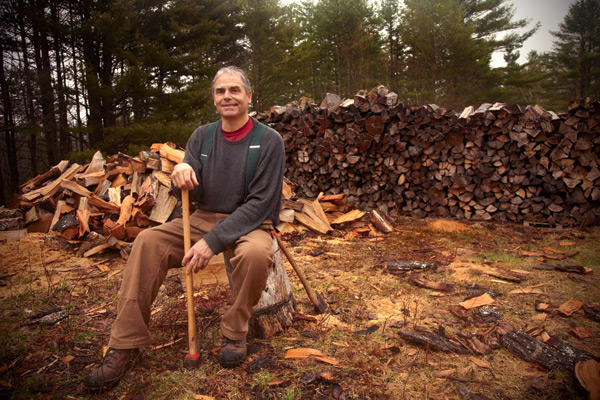
For more than 30 years, Stephen Philbrick has heated almost exclusively with wood—this despite the fact that for much of that time Philbrick’s western Massachusetts house has been a “drafty” 1806 Federal. In a typical year he burns through 10 cords, all of it from his property, all of it split by hand by Philbrick himself. “I love it,” says Philbrick, a published poet and a Congregational minister. “It’s my therapy. It’s my recreation. It does wonders for your patience if you can go out there and hit something absolutely as hard as you can.”
Pick the Best Hard Wood for Heat
Dense wood is good firewood; that’s why hardwoods are preferable to softwoods. But not all hardwoods are created equal. Avoid poplar, a light wood with limited grain structure. Sugar maple is better than red (swamp) maple. Ash dries fast, and its straight grain makes it easy to split. And yellow and black birch are toastier than white birch. Your best bets? “Beech and oak,” Philbrick advises. Hickory and hornbeam are excellent, too, but a little harder to find in New England.
Split Wood with a Maul
A maul, not an axe, is what you want for splitting wood. A good maul (costing about $70) has a head that weighs at least six pounds, with the bulk of that weight resting behind the handle. That gives it more force. Philbrick stands his target up in the middle of an old tire. “If you hit it and it doesn’t split, it doesn’t fall over,” Philbrick says. “You can just reach over with the maul and stand it back up.”
Stack Wood for Air Flow
When it comes to drying wood, air is your friend, so stacking is critical. “There are all those openings, which air can get through,” Philbrick explains. He stacks on top of stringers, so that air flows under the rows, while also making sure the piles are at right angles to the prevailing wind. He never, ever, wraps any stack in plastic; instead, he covers the top with a sheet of plywood or an old piece of metal roofing to keep the rain off. “People who are new to this will proudly say how they covered their piles tightly,” he says. “Well, after a year, with all that trapped moisture, it’s all punk.”
Test Wood for Moisture
Well-dried wood is easy to detect; its color is more muted. Cherry’s split grain, for example, goes from orange to a weathered gray. Wood’s scent changes, too. Freshly split oak has an almost sour smell to it, which disappears after it’s dried. Check marks (cracks) on the ends of the pieces are also a sign. “Try smacking two pieces together,” Philbrick says. “Green wood kind of thunks. Dry wood has a ring to it.”
Choose the Best Kindling
A great fire begins with a good source of kindling. Aged pine branches are an excellent choice, as well as a carpenter’s lumber scraps. You can even try a slightly unconventional route. “A bunch of people around here go to a casket maker in Northampton,” Philbrick says. “He’s got fabulous pieces that aren’t very big.”

Get bonus content not published in the magazine in our premier e-mail newsletter.


I’ve always wanted to heat with wood, but it’s always seemed like an insurmountable time commitment.
I love the smell of a wood fire in the winter.
If only I knew about this when I still had a wood stove! Great info, thanks.
Dave
Hi Stephen,
I miss my wood stove so much, the aroma of wood burning is just a memory since last year. The expense of purchasing wood, dealing with the ashes, etc to this busy widow just became too much. Last fall I purchased a pellet insert for the fireplace and while it may not have the same aesthetic appeal, it appeals greatly to my needs – warmth and less labor, but also the fire is real, so I sit here and pretend………
Happy winter,
Rosalie
I had a gas fireplace added to my manufactured home. Best thing ever. At my age I can’t chop wood and this was the closest alternative. It also cuts down on running my furnace all the time. Don’t really miss the smell, I just light a nice fragrance candle and sit back……………………. Keep warm, Cynthia
Just a note from Northern California, where we have been heating only with wood for more than 35 years. We cut the wood off our 96 acres (usually), and have a fireplace insert. Once it starts in the fall, it’s going until early April, when it’s warm enough here to stop. I get my chimney cleaned at least once a year, which is critical to eliminate chimney fires. Also our chimney has been lined all the way down to the insert, which is a safety feature in case of a fire. We priced a heating unit for the the house and it was $10,000! I guess we’ll keep heating with wood!! One thing we did was put insulated windows in and we have porches around the house that we close off all winter, providing more insulation. Plus we only heat the center of the house. That’s what electric blankets are for! I do throw a plastic sheet over our wood, but it’s not tight and we take it off when the sun is out. We burn oak.
96 acres,,, wow it must be beautiful.
Because I bought 2 tons of wood pellets last fall to burn over the winter in the fireplace insert, the winter was so mild I only burned a few bags, so will not have the expense this year. I do have a back up furnace that heats the hot water. I need to figure out how – or if I can – make the hot water heater electric, since that is the only reason I use the furnace in off heating months. I am hoping we have a bit more snow this year – something about winter in Vermont without snow really chills me! Think I’ll have a strawberry margarita……….
We have been heating with wood since 1980 in RI. For the last 3 years we have been burning ENVI blocks. We buy them by the pallet. One pallet is 1 ton. We have 2 pallets delivered at a time, and bring one inside. The blocks come 3 to a package and are shrink wrapped. No mold, no bugs, just clean. No build-up in the chimney. We do clean it every year, but lately, not much to clean. Probably a little more expensive than wood but easily worth it. No stacking, easy storage and easy to use. Keeps us nice and warm, and is a lot easier than cord wood.
Before I moved to Florida I lived in Upstate New York. I heated my house with a Woodstock
Soapstone Stove. In my opinion it is one the best wood burning stoves ever made. I cut a hole in the kitchen floor, directly over where stove was located in the basement, installed a register. In the morning I fired the stove up and when i returned from work in the pm. the stove was warm with a good bed of coals and the house was warm. I set my oil furnace thermostat at 55 degrees and it rarely ever came on unless the temp dipped to -20 or below. I heated mainly with two year old dry, red oak.