




Patriots’ Day Reenactment | Two Mornings in April
Above the din of battle in Lexington and Concord, you may hear the echo of history at these two Patriot’s Day Reenactments in Massachusetts.

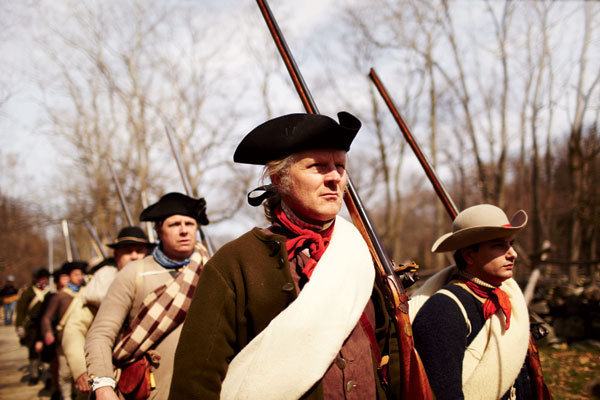
Patriot reenactors march toward Hartwell Tavern in Lincoln.
Photo Credit : Jonathan Kozowyk and Henry HungPhoto Credit : Jonathan Kozowyk and Henry Hung
SLIDE SHOW: Patriots’ Day Reenactment
A ragged band of Americans march tiredly towards the North Bridge in Concord, Massachusetts. It’s a cold, gray morning here in Minute Man National Historical Park, and from somewhere in the mist the sounds of a fife can be heard. As they hunker beneath their hoods, a sense of quiet anticipation furrows the brows of the assembled men. Then the fateful cry goes up: “Hot coffee and pie!”
Huzzah! I think. I could use some pie. I duck out of the line of bleary-eyed tourists and quick-step over to the big white tent in front of the Old Manse, Ralph Waldo Emerson’s family home, which sits just feet from the site of the battle. I’m not in the habit of eating apple pie at 7:30 in the morning, but Patriots’ Day comes only once a year.
But this isn’t actually Patriots’ Day, which officially lands on the third Monday of every April. Not many people get that day off, so the National Park Service holds its major reenactments on the Saturday before, hoping for bigger crowds. Ironically, this means that the reenactment of the battle at Concord happens two days before the one at Lexington, but only the most hardcore history buffs make a fuss about it.
Pie in hand, I continue toward the bridge and catch my first glimpse of the British. A small cluster of Redcoats are queued up in front of the public restroom by the road. By the bridge, the crowd of tourists starts to swell. There are several dozen families as well as a large group of high-school students, and I try to guess how long it will take them to run out of jokes about knickers. I settle in behind a man who’s there with his young son.
They say that 95 percent of war is waiting, and the same could be said of historical reenactments. Somewhere at the head of the crowd, a park ranger is reciting the story of this day, but the PA system is squawky, and most of his words are lost. The crowd undulates as people shift their weight from one leg to the other and back again. I fantasize about more pie.
Just then, the sound of a drum comes beating from the parking lot as the British form up. Across the bridge, a thin formation of Patriots starts its march. The British brush by where I’m standing in the crowd, and the man in front of me bends down by his son and points: “Those are the Redcoats! You see them?”
Moments later the two sides meet, one at either end of the bridge. Both forces present arms, then shift their aim 45 degrees to the right and shoot harmlessly over the creek. These aren’t warning shots; this is the battle. You’re not allowed to fire a gun–even an unloaded replica during a reenactment–on Park Service land. It’s also against the rules to pretend to be dead, so no one falls down on either side. High drama it’s not, but if you’re here to be entertained, you’ve missed the point.
After a few rounds, the British break and run, and a cheer goes up amid the crowd of onlookers. “That’s it,” the man in front of me says to his son. “That’s the start of the war.”
Well, kind of, I want to interject, but I hold my tongue. Patriots’ Day isn’t a time to debate the finer points of history. The boy is smiling, and that’s good enough.
A few hours later, I find myself behind a pack of excitable but slow-moving Boy Scouts on the path that hugs the old road that the British followed as they retreated back to Boston after the shots at Concord.
The boys take turns describing how they would kill a British soldier. “I would cut off his head,” one shouts. “Well, I would cut off his head and then shoot his head!” boasts another.
There are enough national studies, political gaffes, and Tonight Show “Jay Walking” segments to prove that we as a culture are not that interested in our own history. The boys in front of me are the exception. They’re still at the age when history is inherently interesting because it’s the subject in school that most closely resembles a Mel Gibson movie. In a few years, though, it will be harder for them to imagine phantom Redcoats darting among the trees. Most will lose interest. Those precious few who don’t will become history nerds, and from there it’s a short, slippery slope to becoming a historical reenactor.
There are far more reenactors in this country than you’d ever guess, a fact that’s easy to see at the park’s annual “Battle Road” events. For Revolutionary reenactors, this is their Woodstock. Units travel from several states to participate in this day of demonstrations, which culminates in the reenactment of the battle at Meriam’s Corner.
The Scouts and I round a bend in the road, and the treeline opens up on a small field filled with scores of people dressed in striking red British uniforms. Some of them are cooking over campfires, while others are just talking with the tourists. A line of regulars is undergoing inspection, blocking the path ahead. A woman in bright-purple jogging shorts squeezes around the line of soldiers. On any other day this park is a popular running path, but today, much to her surprise, it’s an 18th-century encampment. The British commanding officer chuckles as she offers him an embarrassed, “Hi, sorry,” then continues down the path, jogging a little faster than before.
If you ask reenactors why they get into this, you get a lot of answers, but ultimately the conversation always comes back to one common theme: fun. In this country it’s common to dress up like the thing you’re passionate about, whether in a Tom Brady jersey at a Pats game or a Starfleet singlet at a sci-fi convention. We take our fandom seriously. Reenactors are really no different; they just root for something more important than pop culture.
In a few minutes, the Redcoats form up and begin their march to Meriam’s Corner. After the shots at Concord, the British were subjected to a string of ambush attacks all the way back to Boston. Meriam’s Corner was the largest of these skirmishes, and as such it’s by far the largest reenactment of the weekend.
The same Park Service rules apply. No one falls down, though with so many people on the field, it’s less obvious that they’re not aiming at one another. The colonial forces attack, retreat, and reform over and over again as the British column moves slowly but steadily down the road. At times, it’s hard to tell exactly what’s going on, and a reenactor would later confess to me that this battle is probably more for themselves than it is for us.
It’s their payoff for all the regimental meetings, the hours of drills, and the time and money put into crafting their uniforms. On any other day someone might scoff at the $1,200 someone paid for his musket or the hours he spent hand-sewing a pair of breeches–but not today. Today the reenactors get to take center stage amid the gunsmoke, the shouted orders, and the billowing banners, while the rest of us stand on the sidelines and watch.
A person’s connection to history is personal. Some people feel it; others don’t. Later I would talk with Charlie Price, a Lexington Minuteman who works as a park ranger in Concord. “I spend a lot of time at the North Bridge,” he tells me. “People come up to me and ask, ‘So what is there to do around here?'” As he says this, his voice rises, as though he can’t fathom how anyone could be ignorant of the sacredness of the place. Those tourists may as well have asked the same question of a priest in his church.
Reenactments aren’t so much entertainment as they are interventions: They’re an attempt to bridge that divide between those who never stopped caring about history and those who did. Reenactors don’t necessarily want you to join your local militia; they just want you to pay attention, open yourself up to the ghosts in the place, and for at least one day, see the British darting amid the trees again.
On Patriots’ Day you have to wake up awfully early to love your country in Lexington: Diehards stake out their spots along the town green at 3 a.m. If you arrive after 4:45 a.m., the crowd is so thick you can’t see the field from the back. Locals have found a few ways around this. Rooftop seating abounds on the regal homes that line the green. For those less well connected, ladders are a popular choice.
One man rolls a little red wagon, piled high with materials, down the street. He quickly deploys two ladders, then slides a painter’s bench between them. He has a gaggle of small children with him, and he hoists each one like a sack of potatoes onto his perch. Then he climbs up one of the side ladders and leans out, one arm hooked around a rung, looking for all the world like a proud sea captain in his riggings.
I’m astonished by how many people turn out at this god-awful hour. I hear a man joking about it with his buddy: “One year the British win and the next the Americans do. They change it up to keep the tourists happy.” But, of course, they don’t. The players stick to the script, and if you’ve seen it once, well, you’ve seen it. And yet every year the crowds come.
Tradition is part of the appeal, of course, but to a greater extent I think it’s town pride. If you ask anyone anywhere else in the country where the Revolution started, they’ll reply (provided they know), “LexingtonandConcord,” as though it were one place. That doesn’t fly here, and each town claims to be where the Revolution really began.
I ask a very proper-looking woman where she stands on the debate, and she gives a little laugh, then says, “Can you tell time?” The Battle of Lexington did indeed take place before Concord, and the casualties here sparked the conflict that would occur later in the day. Still, Emerson didn’t write “Lexington Hymn”; he opted to place the “shot heard round the world” just outside his family home at the North Bridge. Concord benefited from the fact that we tend to remember history based on the stories people tell about it rather than what actually happened–or, as Sean Kelleher, a Lexington Minuteman, put it, “They had a good publicist 60 years later who wrote a nice poem.”
As the sun begins to rise, a police officer’s walkie-talkie crackles, “Unit 1, British on the march.” The message elicits a small laugh from the crowd. With little fanfare, the Minutemen form up in a line on the green and await their opponent.
Unlike the colonials at Concord and Meriam’s Corner, the men on the green here aren’t reenacting generic soldiers. History recorded the name of every man who fought at Lexington, and when you join the Minutemen, you’re assigned one of them. You learn his story; you carry his legacy forward. On the line, Bill Poole stands ready with his musket; he’s reenacting his great-great-great-great-grandfather, Ebenezer Locke. Down the line from him is Henry Liu, whose ancestors were in China when this battle happened.
Soon, the British arrive on the green in grand fashion, their legion dwarfing the small Patriot contingent. True to history, some of the Patriots flee before any shots are fired, running off the green, across the street, and through a neighbor’s side yard. The British order the Patriots to disperse, the Minutemen refuse, and then somewhere off the green someone fires a musket and all hell breaks loose. The British fire a salvo into the American formation. This isn’t Park Service land, so any Minutemen who are reenacting soldiers who died or were injured fall to the ground in front of the British assault. The Redcoats give a cheer and rush across the green. A young man in a British uniform dashes in front of a New England Cable News film crew, glances quickly to his right to ensure that he’s framed up, then fires his musket. Compared with Concord, this is like a Broadway production.
The last of the Patriots retreat across the street, and the British regroup and march away. Women in colonial dress emerge to tend to the dead and dying. It’s a quiet, solemn moment, and the spectators pause to appreciate it. An announcer reads the names of the dead over the PA system. Upon the final name, the reenactment ends.
On April 19, 1775, no one knew what these shots meant. It would be another two months before George Washington took control of the new Continental Army, and more than a year before the country would get around to declaring independence. The only thing that was clear was that a handful of citizens in Massachusetts had unilaterally declared war on the most powerful empire on earth. Imagine the anxiety they faced when the sun set that day. Luckily, we don’t have to.
Today the dead rise off the green, dust themselves off, and pose for pictures. The crowd converges on the battlefield, and visitors shake hands with reenactors. In a few minutes, everyone will head over to St. Brigid’s church for a massive pancake breakfast.
In this way “historical reenactment” is an oxymoron. We attempt to make the past live again, but the very fact that we live in a society where we have the luxury to even try means that we’ll never truly succeed. It’s impossible to know what the world would be like without the battles of Lexington and Concord, or to express our gratitude for what happened there, so we create these little rituals instead. It’s like a child’s first birthday. He or she doesn’t care and will never remember, but our hearts would break if we left the day unobserved.
And so we gather around this little green at dawn. We light the candles on the cake, sing “Yankee Doodle” to the country, and then, in dramatic fashion, blow them out with a concussive musket blast from 20 yards away.
For details and schedules for this year’s Patriots’ Day festivities, visit: nps.gov/mima and battleroad.org.

Justin Shatwell
Justin Shatwell is a longtime contributor to Yankee Magazine whose work explores the unique history, culture, and art that sets New England apart from the rest of the world. His article, The Memory Keeper (March/April 2011 issue), was named a finalist for profile of the year by the City and Regional Magazine Association.
More by Justin Shatwell