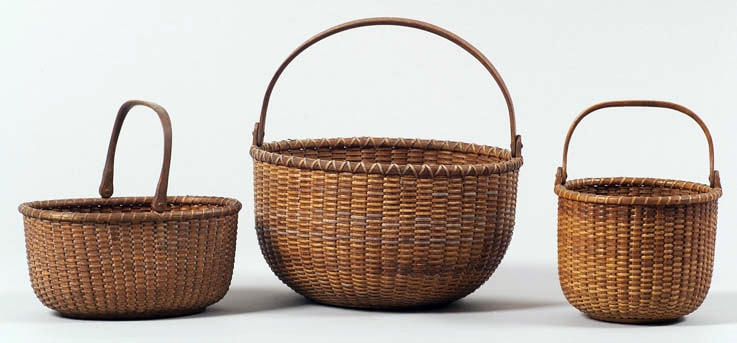
The earliest forms of Nantucket baskets were utilitarian creations, made free-form using wooden splints woven to a round pine-board bottom. During the 1860s, basket making aboard the lightships became an art form. I tip my hat to those plucky 19th-century seamen who first manned the lightships off the shores of Nantucket. Unlike the world’s great […]
Photo Credit : Courtesy of Nantucket Historical Association
The earliest forms of Nantucket baskets were utilitarian creations, made free-form using wooden splints woven to a round pine-board bottom. During the 1860s, basket making aboard the lightships became an art form.
Nantucket Baskets Photo Credit : Courtesy of Nantucket Historical Association
I tip my hat to those plucky 19th-century seamen who first manned the lightships off the shores of Nantucket.
Unlike the world’s great and tortured artists, I’ve never found periods of isolation, loneliness, and boredom to be inspiring or productive. For me, they don’t summon the muse; they only beget more of the same.
These hardy souls not only endured months of desolation in solitary confinement at sea, they created a unique art form, both beautiful and purposeful, known as Nantucket lightship basketry.
In the 18th and 19th centuries, the foggy shores of Nantucket were some of the most treacherous in the Atlantic. More than 100 whaling ships and trading vessels were shipwrecked there. Whaling captains petitioned Congress to anchor “lightships,” essentially floating lighthouses, off the shoals around the island to help vessels navigate the dangerous waters. Sailors stationed aboard these ships made baskets as a way to pass the time and to earn extra income.
The earliest forms of Nantucket baskets were utilitarian creations, made free-form using wooden splints woven to a round pine-board bottom. During the 1860s, basket making aboard the lightships became an art form. Attached to molds, round and oval baskets were woven of cane or rattan. Handles were made from bent oak or hickory, and bottoms were made of cherry, oak, or maple, hand-turned on a lathe and beautifully shaped. This cottage industry flourished with interest from islanders and tourists alike. Fitted nests of baskets were designed, ranging in size from a few inches up to nearly two feet in diameter.
Makers such as Captain Charles Ray and George Washington Ray produced some of the finest examples of Nantucket baskets ever made. Originally selling for as little as $1.50, Nantucket lightship baskets now fetch several thousand apiece, with complete nests bringing tens of thousands, even six figures at auction.
By 1900, the sailors’ pastime of basket making had all but died out. Back on the island, artisans such as “Mitchy” Ray and Jose Formoso Reyes carried on the lightship tradition; today, contemporary makers still create baskets by hand. Perfectly woven and delicately polished, they are beautiful, to be sure. But they’re not for me.
I feel compelled to search for one that holds a century’s worth of dust among its lacings. I could tell you it’s because I like the wear on the handle and the soft color of the original surface. But in truth, I think it’s an attempt to bridge the time and distance between myself and that forlorn sailor who spawned a thing of beauty out of sheer isolation, loneliness, and boredom. Now that’s what I call a light in the darkness.
Catherine Riedel represents Skinner Auctioneers and Appraisers of Boston. skinnerinc.com