




Stone Wall Defender Robert Thorson
SLIDE SHOW: New England stone walls by William Hubbell, from Good Fences: A Pictorial History of New England’s Stone Walls (Down East Books, 2006; $29.95) When geologist Robert Thorson came to work at the University of Connecticut in 1984, he was smitten by stone walls. In all his travels–from Minnesota to the Pacific Northwest to […]

To learn more about Robert Thorson’s work, his upcoming lectures, and his books, go to: stonewall.uconn.edu
Photo Credit : Robbins, HeathTo learn more about Robert Thorson’s work, his upcoming lectures, and his books, go to: stonewall.uconn.edu
Photo Credit : Robbins, Heath
SLIDE SHOW: New England stone walls by William Hubbell, from Good Fences: A Pictorial History of New England’s Stone Walls (Down East Books, 2006; $29.95)
When geologist Robert Thorson came to work at the University of Connecticut in 1984, he was smitten by stone walls. In all his travels–from Minnesota to the Pacific Northwest to Alaska–he had never seen anything like them. “I was fascinated by them,” he recalls. “It was like seeing a tree if you’ve spent all your life in the desert. And of course everyone around here just took them for granted.”
What began as fascination eventually grew into mission: Over the past 25 years, Thorson has become the region’s foremost expert on stone walls.
He’s written books, given countless lectures, advised local conservation and historic preservation groups, and with his wife and co-author, Kristine, coordinates an educational organization called The Stone Wall Initiative. Increasingly, urgently, he has raised an alarm over the destruction and loss of what he calls New England’s signature landform.I’m sitting with him now at his house in Jamestown, Rhode Island. Sugar maples, white-steepled churches, Town Meeting, lobsters–you can find those in other places, he says. And you can find ornamental stone walls elsewhere: “But only in New England are they a part of the landscape. Only here would you have to explain the absence of stone walls.” He might add “Old England,” as well, for he has described the almost-unique geologic history the two places share–how similar maritime climates eroded and lifted and worked on the landforms in similar ways, how the advancing glaciers of the Scandinavian Ice Sheet stopped just short of London in southeastern England, and those of the Laurentide Ice Sheet just short of Nantucket, Martha’s Vineyard, and Long Island Sound. The grinding and fracturing upshot of all this was a similar, wide distribution of hard-rock fieldstones–stones that were almost uniformly the size and shape that a man could lift easily and fit together into a rough wall that would stand for centuries.
Yankee farmers built walls of stone as they cleared the land, and continued to build walls into the mid-19th century: for confining livestock and marking boundaries, for lining roadways and penning sheep, for damming and crossing streams, for house and barn foundations. But primarily, above all else, these farmers built walls–crude, tossed walls–to hold the debris removed from rocky soil. No official inventories were ever taken, but an 1872 U.S. Department of Agriculture report on fences suggested that by then some 240,000 miles of stone walls crisscrossed New England. As Vermont writer Castle Freeman Jr. wrote more than a century later, “… if a stone wall a fraction as long as the walls of Vermont alone had been built by the order of some old king or emperor, it would be one of the wonders of the world.”
Those walls, Thorson tells me, are New England’s archaeological ruins, and should be protected as such. And then on his computer he shows me photos of destruction: bulldozers clearing old walls to make room for bigger lawns; remnants of walls left behind by thieves; “McMansions” in “Fakeville” where weathered, lichen-covered stones trucked down from upcountry have given the fresh landscaping instant history and authenticity.
“The market for stone-wall stones is growing,” he says, “but there’s no regulation, no way to track how many walls are being strip-mined.” He knows they come mostly from the stone-rich, land-poor parts of northern New England and go to the stone-poor, land-rich parts, particularly southwestern Connecticut. Indeed, when I get home and do a quick computer search for old fieldstone for sale, I find two sources within a minute: one from Midcoast Maine and the other from Vermont’s Northeast Kingdom.
Thorson takes me on a driving tour, as we pass impressive waist-high walls carefully laid and haphazard-looking walls overtaken by weeds. He cites progress: how he’s recently lent his support to a group of Framingham, Massachusetts, citizens who want to rewrite the state’s century-old law, which makes stealing stone walls a crime punishable by a maximum fine of only $10; how citizens in Smithfield, Rhode Island, have crafted local ordinances that go beyond the state’s “Leona Kelley” stone-wall preservation act of 2001; how he passed a skidder at a logging site the other day that had carefully worked around an old boundary wall, so as not to disturb it.
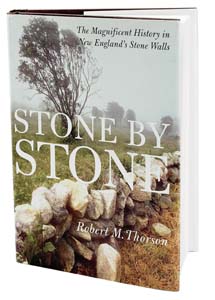
We step out of the car at an old Quaker meetinghouse at the top of a gentle rise of open land bounded by stone walls, across from a farm that has just been protected through a conservation easement. Thorson shows me the rough, gray walls surrounding the meetinghouse, walls where he used archaeological clues to confirm the rumored site of Revolution-era graves. I put my hand on a wall, damp from an April shower. Knowing that thin thread of history somehow deepens my appreciation for the place where we’re standing. And there’s no way it should have, but it makes me feel more connected to the place we all live. In the introduction to his book Stone by Stone, Thorson wrote, “Although inanimate, stone walls have an important story to tell. They give us a clock by which we can judge the passage of almost unimaginable time.”
To learn more about Robert Thorson’s work, his upcoming lectures, and his books, go to: stonewall.uconn.edu
____________________________SLIDE SHOW: New England stone walls by William Hubbell, from Good Fences: A Pictorial History of New England’s Stone Walls (Down East Books, 2006; $29.95)
