




Lowell, MA: Poet Paul Marion
Mr. Alphonse Hudon, / wearing a blue parka and dress hat, / leans on his cane on Pawtucket Street, / checking the freshly tarred walk / and grove of short pines / along the Northern Canal. / “Looks good, doesn’t it?” I ask. / And he says, “I liked it better the way it was,” […]

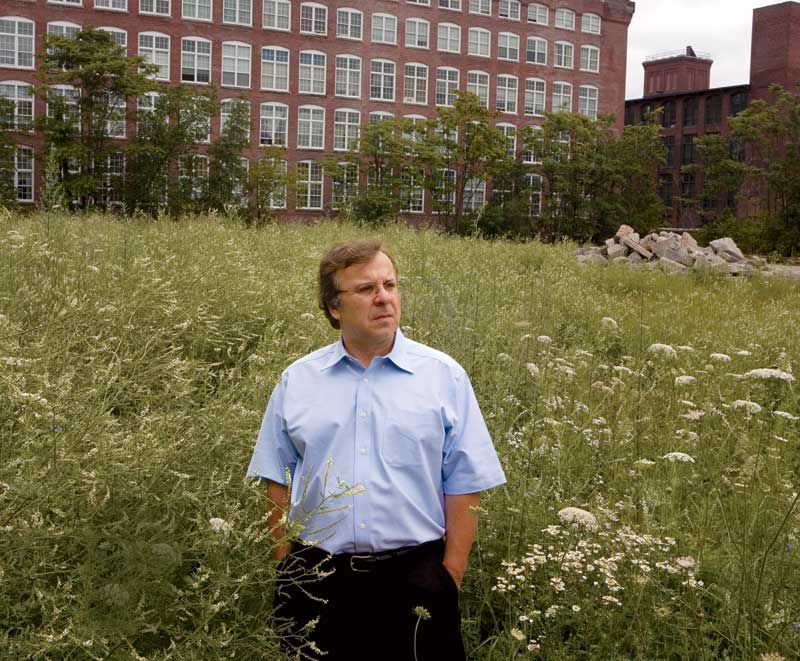
Paul Marion
Photo Credit : Dana SmithMr. Alphonse Hudon, / wearing a blue parka and dress hat, / leans on his cane on Pawtucket Street, / checking the freshly tarred walk / and grove of short pines / along the Northern Canal. / “Looks good, doesn’t it?” I ask. / And he says, “I liked it better the way it was,” / which opens up a line of talk …
The poem goes on to tell of the conversation the two men had that day: Mr. Hudon, the older man, telling the younger one–the poet–how he used to know his father, and his grandfather before him, and an old neighbor named Mr. Marquis, who, 60 years ago or so (“before the wrecking cranes pulled up”), owned a filling station near the spot where they’re talking. The young man recalls a house he knew as a child, a block or two away, with a tree growing through its porch roof. “Oh yes,” the old man remembers, “that was Mr. Marquis’ house. / And there was a monkey there, too …”
Mr. Hudon is probably gone by now. He was old already then, and those lines were written years ago. And the village he remembers has been gone now more than 40 years–its only memorial a bronze plaque on a granite slab squeezed onto a narrow spit of grass a block south of the Merrimack River in Lowell, Massachusetts, a minute’s walk from where he and the poet had their talk: “On this site grew the heart of the Franco-American community. Hard-working French Canadians came to fill the mills of Lowell …” The granite was cut “from one of the last blocks … to be torn down.” And around the plaque’s sides, a border of street names, a fleur-de-lis at each corner, and two dates: 1875-1964.
It was the poet himself who first brought me here, on a summer day more than a year ago, to deliver on his promise to show me the city of his poems. He’s been writing them now going on 35 years, since before he finished college: poems about bars and laundromats and textile mills–“cotton was king” here, but there were wool mills, too; about boxers and politicians, God, death, young lovers, work, baseball, the weather. Nine collections–Strong Place, What Is the City? and more–plus essays, co-authorships, and editing several titles, including Atop an Underwood, a popular collection of Jack Kerouac’s early writings. And at the heart of nearly all of it is this city where he was born. It is both his muse and his dearest subject, and the cause around which he builds his working days. His devotion to it defines him. I may never have known anyone who loved any place more.
His name is Paul Marion. We’d come that day from our offices at the University of Massachusetts at Lowell, where Paul wears a suit and tie and plans community outreach projects, and I write and teach part-time. For more than five years, we’d worked in the same office–although we didn’t anymore–and I had come to value his warmth and wit, his vast knowledge of the city, and his love of the Red Sox.
And at least once every summer for the past eight years or more–because as much as he follows the Red Sox, he loves the Lowell Spinners more–we’ve sat together in the box he rents for the season at LeLacheur Park on Aiken Street, just three rows back from the field, and shared beer and kielbasa while the sun drops behind the scoreboard.It was around that time last summer, a week or two before our Spinners outing, that I went with him to the little granite memorial. Our tour had begun several days earlier, when we’d met after work at his house. It’s a grand house, in an un-grand part of the city, a mile or so south of the memorial: six bedrooms, Italianate, all brick and stone and high windows, built 150 years ago at the peak of Lowell’s textile ascension, home to the agent of the old Appleton Mill, the city’s largest at the time.
It’s bifurcated today–with Paul, his wife, Rosemary, and their 13-year-old son, Joseph, in one half; the other half the home of his in-laws, who have lived there 50 years. Rosemary grew up in the house; her great-grandmother once worked there as a maid, before her son, Rosemary’s grandfather, bought the place nearly 80 years ago. Joseph, both parents tell me proudly, is the fourth generation of their family to live there.
They explained all this to me over beer and peanuts in the oversized dining room, while Paul–who seems alternately proud and embarrassed by the grandeur of the home he’s married into–came and went with family photos: of his grandfather the butcher, pictured in an apron in front of his market; his father the mill worker (“People always said he looked just like Sinatra”); Doris, his mother, who sold coats and dresses for 25 years in a women’s department store downtown. He was in his element, and it showed: telling stories, shuffling photos, eyes alight, between what may be his two favorite subjects in the world, his family and the city of Lowell.
He talked about his father’s job in the textile mill–the filth, the long hours, the years and years of daily drain. “I don’t know how he stood it,” he told me. “I got a job there one summer as a kid, cleaning the drains in the scouring plant–where they scour the dung out of raw fleeces with nothing but hot water and lye. The stink was unbelievable. I think I lasted two days.” This took him to the subject of Lowell’s mills in general–the wool uniforms for World War II soldiers, for the Union Army the century before–and from there to the immigrants who manned the spinning machines and the looms.
“The Irish were the first ones,” Paul said. “Then the French, the Canadians–my great-grandfather, Joseph, in 1880, he was one of the early ones–and then the Greeks after that. But the Irish ran things for a pretty long time. The French were second. It wasn’t till ’36, I think, that we had our first French mayor …”
The talk turned more personal later that evening, over dinner at an Irish pub downtown, where he shared with me, between interruptions (you can’t sit down with Paul for long in many places in Lowell without someone calling his name), some of the quiet sadnesses his family had borne: his shopkeeper mother, Doris Roy Marion, who had never finished high school but who once boarded a silver railcar from Boston for a training program with Charles of the Ritz in New York, then caught the flu and came home (“I found the training manual years later cleaning out her dresser”); his father, a shy, quiet man who mapped out retirement trips to California and watched symphonies on TV (“kind of a closet intellectual without the education”), but gave his whole life to his mill job and died of cancer at 62.
“They were good people,” he said to me. “Good working people. They dreamed dreams. But all they ever knew of life was work.”
It was a side of Paul you rarely see, outside of his poetry. He’s an affable man, very gentle in his ways, with wide brown eyes, a round face, and a story or clever remark about almost any subject you could name. There’s a dreaminess about him, too, that comes across the first time you meet him–from his eyes, his slight smile–it’s hard to know from where. You have to make the time, and do some digging–or hit just the right nerve–to get to where the poems come from.
I remember the first time I saw this. It was four or five years ago; I was teaching a class in freshman composition and had assigned a Paul Marion poem, “Majestik Linen,” about a worker in an industrial laundry somewhere in Lowell, seen through a window on a Sunday-morning walk: “She turns back to her work, what most of us won’t see / unless we’re in the Flats at the hour of the early Mass, / following the drone of automatic washers / to a sunrise service recognized worldwide …” A student in the class, a boy of 18 or 19 who rarely if ever shared his thoughts, raised his hand to tell me, with what seemed like genuine wonderment, that he recognized in the poem–he was very sure of it, he said–his mother’s place of employment.
I told Paul about it the next time I saw him. His delight was as plain as a child’s. “That’s wonderful,” he said. “He saw through the poem to his mother. He saw that place as a subject of literature. That made it matter for him. That gave it dignity.”
Around that same time, I moved to Lowell from a small town in New Hampshire about an hour away. I had worked at UMass Lowell nearly five years by then, and had a pretty good sense of the city’s past and present: the mill girls and millionaires of the 19th-century boom years; the slow obsolescence; the bottoming out through the ’60s and ’70s; the wax-and-wane cycle that followed; the flood of Cambodians that followed the Khmer Rouge genocide.
I knew about the blight, the muggings, and the gang violence, but also about the galleries, the small museums, the repertory theatre, and the artists’ lofts downtown. I knew the city had been down and up and down again enough times to develop a sense of tragedy. But I liked that you could sit in deep cushions in the Caffé Paradiso and eat Italian pastry at 11 o’clock at night, and that there were real-imitation gaslights on Palmer Street, and that you could go to a pro baseball game for eight dollars, and that some of the streets still had cobblestones.
I liked what the city was on its way to becoming: a place where people honor the past but don’t cling to it, and where a future is unfolding as you watch. Half a mile from the cobblestones is the 6,500-seat Tsongas Arena, spanking-new, of brick and glass, which has hosted Bob Dylan, Liza Minelli, Van Morrison, and the Boston Pops, along with Serena Williams, the World Wrestling Federation, and the World Men’s Curling Championships. The old mills and boardinghouses are today’s condos and artists’ lofts. Walk a mile along the river and you’ll see everything from the ruins of 100-year-old coal sheds to the site of the UMass Lowell’s new nanotechnology center. Something exciting is happening: a newness, a kind of hipness peeking out from under the drear, that makes you want to be a part of it.
Part of Lowell’s appeal, too, was Paul and other people like him–other artists, because the city is full of them. I was hoping that I might find some of the same gritty, life-grounding energy he was always talking and writing about. I did find the energy, but in the end it wasn’t enough to hold me–other things came along–and I left after only two years. I’ve sometimes wondered since, though, whether I gave it enough of a chance.
It’s several days after our pub dinner. We’re standing now on the little grass island, deciphering the memorial, talking about the city’s immigrant past. On one side is a company parking lot, mostly vacant now; on the other, the rear wall of the university’s glass-and-concrete recreation center. It’s late afternoon, warm and nearly cloudless, but even now the sidewalks around us are empty. It seems an unlikely place, I tell Paul, to memorialize anything. “Yes,” he answers, “but here is where it all was.”
This starts him on the stories. He’s so full of stories, and of their connections to one another and the lessons he sees in them, that when he goes to tell you one, it will start out clear and linear, like anyone’s family story, but then branch out and loop back and link up with others, until what you thought was a simple piece of cloth is suddenly a tapestry.
The monument, he tells me now, was placed here by the priests of St. Jean-Baptiste parish, “to mark the passing of Little Canada,” their name for the neighborhood. The church, he says–now standing empty–is on Merrimack Street, one street over from Moody, where his grandfather’s butcher shop was (“His store is a parking lot today”). On every street in the neighborhood–Aiken, Cabot, Cheever, Coolidge, and the others, all the streets named on the monument–“the tenements were as dense as Hell’s Kitchen in New York.” They were so dirty and low-class, he goes on, that his mother, from the Centralville neighborhood on the other side of the river, “wouldn’t be caught dead here as a girl”–but still somehow wound up with his father, who grew up on Cheever Street. This starts him on his father, and the work he did grading wools: “a rare skill,” he says to me now as his thoughts near the end of their looping–and there’s something like pride in his tone–“to be able to grade the wool, one fleece from another, based only on its look and feel …”
The stories go on, sometimes sideways, just as often backward in time: about his father, a machine gunner with the Fourth Infantry Division, who marched across Germany, then came home to grade fleeces in Lowell; his father’s father, Wilfrid the butcher; Wilfrid’s father, the carpenter Doda, who married Rosalba, a weaver on a textile loom; and before Doda, Joseph, also a carpenter, who came south in the 1880s from Quebec. He can trace it back all the way to a merchant named Nicholas, from Normandy, who came with his bride to New France–Quebec–and settled there and raised a family, around 1665.
They’re all gone now. His father’s mill is gone–all the mills are gone–along with the butcher shop, St. Jean-Baptiste parish, the department store. Little Canada was bulldozed in the ’60s–a late victim of urban renewal, which had already taken the Greek Acre and other neighborhoods–to make way for public housing. The downtown emptied: the stores, the Strand Theatre, the sidewalk markets, all shuttered or moved to the malls. Buildings, whole blocks, were burned or flattened; parking lots replaced businesses; the population fell by a quarter; unemployment reached 12 percent. “Somebody ought to drop a bomb on this place,” a high school history teacher told Paul’s brother’s 10th-grade class in the mid-1960s. It was the city’s darkest time.
“They were here, and then they were gone,” Paul is saying now. It’s early evening. We’ve been driving, for the past 30 minutes, the little grid of streets just east and west of the Aiken Street (Ouellette) Bridge, the neighborhoods’ old dividing point, and have come full circle back to the monument’s little grass island. I’ve had the full tour, both sides of the river: the parking lot where Wilfrid’s market once stood; the shuttered old neighborhood church; a blighted, prewar building complex, North Common Village, where men in undershirts sit in clusters on front stoops; the four-story red-brick fortress, St. Louis School, now in its 103th year, where, Paul once told me, his mother and Jack Kerouac, both Centralville natives, were schoolmates nearly 80 years ago; Paul’s birthplace on Orleans Street, still a tidy two-family.
“We can’t have those tens of thousands of lives just erased,” he says. He’s standing a foot or two back from the monument as he says this, sweeping an arm, almost angrily, right to left across his chest to take in the little island, the street and the land behind it, and the river, a block away to the north. He’s been talking, for the last several minutes, about the mills that used to line the shore here: “the armies of workers who tramped through them–Irish, Greek, French Canadian, Swedish, any country you could name,” and how their lives and stories, their comings and goings from this place, were what made him, in the end, want to write his poems.
“People were here,” he says to me now, stabbing a finger first at the granite slab, then at the air and sky beyond it. “There are people inside that piece of stone. Lives were lived here. That had richness. That had value. That deserves to be counted.”
All that history and geography / in a supersaturated marker, / tucked between evergreens on Aiken Street … / You stuck an arm out the window / to touch the next tenement. / You heard one tongue for blocks …
In a short essay at the end of his latest collection of poems, Paul quotes from Joan Didion, describing the relationship between another writer–James Jones–and the place and time he wrote about: “A place belongs forever to whoever claims it hardest, remembers it most obsessively, wrenches it from itself, shapes it, renders it, loves it so radically that he remakes it in his image …”
I’m sure I’ve never known a writer who has claimed any place harder, devoted himself more obsessively to its literary incarnation–and reincarnation–than Paul has Lowell. The difference is that whereas most artists (Jones, Twain, Faulkner, Whitman, Kennedy, Banks) seek to render a place, however lovingly, as a canvas on which to play out some larger truths, for Paul the place itself–and its people–seems the highest truth of all.
“It’s a sort of alternative kind of preservation,” he once said of his poetry to a reporter. “The whole world is in Lowell. It’s so various. Every drama you can imagine, every human condition, is here.” And so he captures and freezes them. Two hundred years of ghosts, like layers of old-growth timber: the wool grader; the Little Canada butcher; the laundry worker; Mr. Hudon out on his remembrance walk through the vanished neighborhood. It’s not nostalgia he’s after; he’s a preservationist. He walks the city on Sunday mornings–it’s an old habit, he says–as though it were a boneyard, in search of sightings, fragments, to fuse together somehow and recast. The bones become his poems, his verse documentaries, his version of the granite marker but more alive by far.
And as they’re read or heard–or assigned in classrooms by teacher-advocates like me–they achieve the goal of all good documentaries: “People have to care about a place. That’s where you begin, by getting them to care, by talking about heritage and shared purpose–a common past–by taking the story of Lowell’s people, its folkways, out into the neighborhoods … That’s been the constant for me, always: using culture as a social glue.”
This hunk of rock on Earth / states its case for the record, / like the metal message boards / shipped out with satellites, / telling somebody out there who we are.
READ MORE: Timeline of Lowell HistoryYankee Classic: Jack KerouacLowell, MA: When You Go