




History of Hard Cider in New England
New England hard cider was once a fixture in every farmhouse basement. Now, brands like Farnum Hill Ciders are ushering in a comeback.

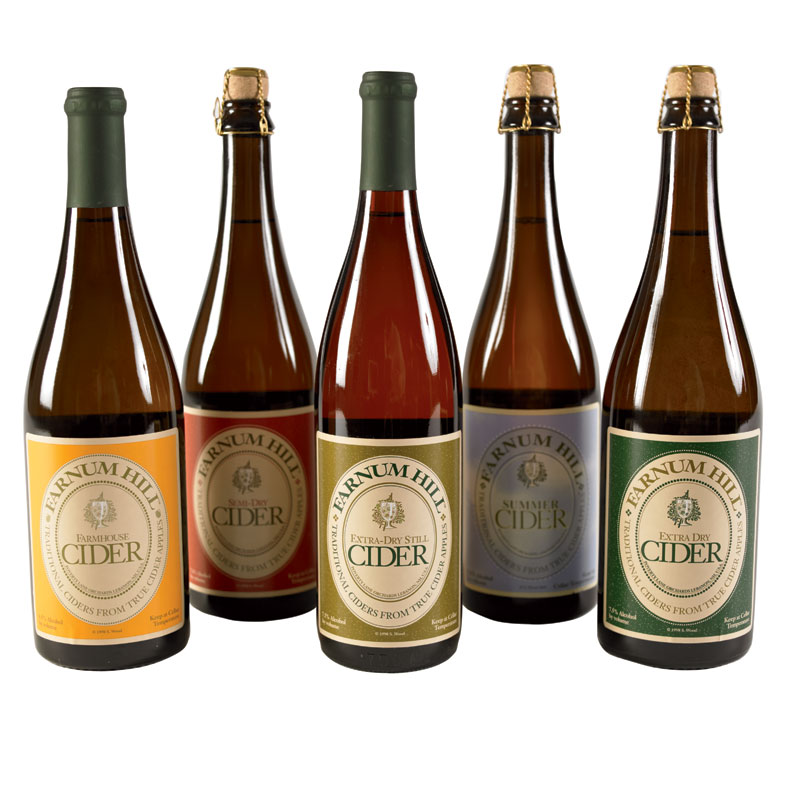
About one-third of the orchard’s business comes from the sale of hard cider.
Photo Credit : Scranton, JessicaBefore we had widespread refrigeration, before anyone needed to make a distinction between “sweet” and “hard” cider, all cider was hard. Throughout much of the 18th and early 19th centuries, it was the most common beverage in New England. Cheap and easy to produce from local seedling apples, the fermented, sometimes fizzy, juice was more popular than ale, kept longer than milk, and in many places was safer to drink than water. Farmers routinely steeped their apple mash and pressed it a second time for less-potent “ciderkin” for their children, and paid their farmhands partly in drink. Larger landholders planted named apple varieties specifically for cider: a mix of bitter, sweet, and tart types, including Gilpin, Smith’s Cider, and Esopus Spitzenberg, among others. Most dooryard cider was run-of-the-mill, but through trial and error, some growers refined cidermaking to an art.

Photo Credit : Scranton, Jessica
But the temperance movement, founded in Boston in 1826, drained away some of the demand in the 19th century. Passionate members took axes to entire orchards. The shift away from an agricultural society–with its attendant waves of urban Italian, German, and Irish immigrants, who preferred their alcohol made from grapes, or barley and hops–took the commercial cider market down with it. Prohibition shut off what little production remained. By 1935, the year Yankee was first published, the once-ubiquitous drink had all but disappeared. Three years later, the Hurricane of ’38 flattened most of the apple trees that hadn’t already been yanked out, cut down, or lost during the harsh winter of 1934.
In their place, farmers planted McIntoshes and Cortlands: thin-skinned, mild-fleshed varieties that grew better here than anywhere else on earth. The high quality of the fruit compensated for the difficulty of managing orchards on the region’s hilly, rocky land. Over the next half-century, those bright-red apples became the profitable signature of New England’s autumn harvest. Hard cider survived mainly in memory.
Steve Wood knew all this when he took over his family’s orchard in Lebanon, New Hampshire, in the early 1980s. He soon discovered something else besides: that even as his orchard was prospering, the future of the New England apple industry was swinging away from the old stand-bys.

Photo Credit : Scranton, Jessica

Photo Credit : Scranton, Jessica
For a time, the spread of controlled-atmosphere cold storage prolonged the survival of short-lived Macs and Cortlands. But a series of changes was steadily eating away the advantages of local orchards. Advances in mechanized picking and transportation favored economies of scale. A big orchard by New Hampshire standards–250 acres, say–couldn’t compete with orchards two or three times that size in the West and upper Midwest, and most of those operations used big, cost-efficient, centralized packing facilities.
Then growers in New Zealand and South Africa created a year-round U.S. market for fresh apples. Supermarket customers’ taste homogenized around large, shiny, waxed, perfectly shaped apples. A decade after Wood had taken over the orchard, the McIntosh market collapsed. The global export trade had changed the game entirely. Speaking metaphorically, Wood says, “Granny Smith was killing us.”
Although he’d graduated from Harvard with a degree in history, Wood nevertheless felt compelled to stay on the farm–to figure out a way to keep his father’s orchard productive, to keep working the land. He and his wife, Harvard classmate Louisa Spencer, began grafting and selling old varieties such as Esopus Spitzenberg (one of Thomas Jefferson’s favorites), tiny Wickson, Golden Russet: tasty types once common in early America but now commanding top dollar as uncommon heirloom eating apples in gourmet shops and high-end restaurants. And when they sensed that heirlooms alone wouldn’t be enough to keep the land paying, they brought back old cider apples, such as Ashmead’s Kernel and Kingston Black, and started pressing and bottling traditional hard cider.
“It was a huge gamble, and people called us crazy,” Wood recalls, sitting down with a glass of his Extra-Dry Still Cider in the bottling room at the end of a day. He and Louisa traveled and talked with old-time cider makers in England and France. They read everything they could find. They experimented with different varieties; discovered which apples grew well in the unforgiving New Hampshire climate; blended them for just the right proportion of sugars, acids, tannins, and fruitiness. Through trial and error, they refined the process. Their timing was good: They jumped into this just as the microbrew and local-food trends were gathering steam. Theirs was real cider, nuanced cider, with the complexity of fine wine. They created a label: Farnum Hill Ciders. And in liquor stores and fancy markets they found a niche.

Photo Credit : Scranton, Jessica
Nearly two decades later, they’ve converted about half of the orchard’s 80 acres to cider trees and are preparing some 20 more for planting. At trade shows and farmers’ markets, Steve and Louisa are on a crusade to introduce a nation of consumers to a product once found in every farmhouse basement and back room in New England.
“Some people still call us crazy,” Wood says, lifting a glass of liquid gold to his lips. The flavor and aroma are subtle, slightly woody; the drink goes down smooth. “We can’t say we’ve won the gamble yet,” he adds. “But an awful lot of orchards have disappeared since we started. And we’re still here.”
To learn more: 603-448-1511; povertylaneorchards.com
