Issues → March/April 2011 → Food →
How to Sugar on a Shoestring
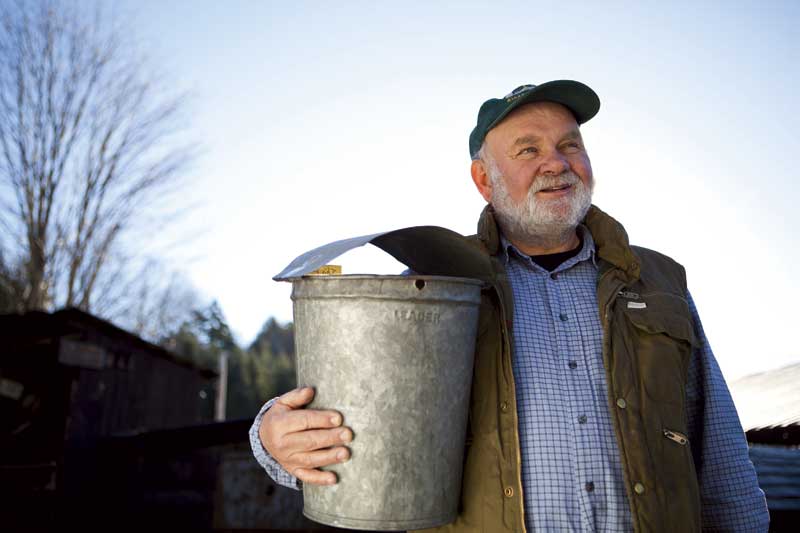
Seventh-generation Vermont sugarmaker Burr Morse lives on his 175-acre farm in Montpelier.
by Ian Aldrich
Video: Sugaring with Burr Morse
Maple sugaring, as Burr Morse will tell you, doesn't require fancy stainless-steel boilers and gravity-fed tubing--simple firepits and recycled milk jugs work just fine, too. Morse should know: His family claims sugaring roots stretching back nearly two centuries, and today Morse sugars from the same trees his granddad once tapped. Come March, his farm, with its country store and farm-life museum, is a destination for maple-hungry travelers. We got the sweet skinny on making maple syrup inexpensively while he boiled sap from his sugarhouse.
You can find out more about sugaring and Morse Farm at:morsefarm.com
Drill, Baby, Drill
You'll never suck enough sap from a tree to kill it, but you can injure it if you don't vary your drill spots each year. Morse is a big fan of steel health spouts, which slip into holes drilled with a 5/16th-inch bit; you can pick them up at supply stores such as Bascom Maple Farms in Alstead, NH. If you live in an area that gets big winters, drill as low as possible. "If the snow melts, you don't want to be reaching up for your buckets at the end of the season," Morse cautions.
Recycle, Reuse
You don't need those postcard-perfect (and expensive) metal buckets to collect your sap. Morse says plastic milk jugs serve the same purpose. Just drill a small hole into the side opposite the handle to hang the jug; when it's filled, you'll have something to grab. Other low-cost items: retired five-gallon buckets for sap collection, used restaurant pans for boiling, and old cinderblocks or flagstones for the firepit.
Quick Time
Reduce boiling time by sticking your sap in a freezer, long enough so that its outer edges begin to freeze solid. The solid stuff is excess water; what remains is the sweet stuff you want. "You often average 2 percent sap, but this way you might be able to get it up to 4 or 5," says Morse. "It may take only 10 gallons to make a gallon of syrup, not 40."
Hot & Heavy
The hotter the fire, the better, says Morse, who recommends soft-wood slabs to feed the flames. "Simmering is not a friend of maple syrup," he notes. When the sap threatens to boil over, throw in a pat of butter to calm the froth.
'Quality Boredom'
Keep a good book nearby; learn to whittle; turn on the radio. Why? Sugaring introduces a lot of downtime. "My dad would start smoking, and I'd find gum wrappers all over the sugarhouse," says Morse. "One time I accused him of being bored. He didn't want to admit it. Finally, he just said, 'Well, it's a quality boredom.'"
Closing In
To decipher whether your syrup is almost done boiling, stick a clean straightedge into your pan--a wide knife, say--then lift it out. If the liquid doesn't drip but instead rolls off in a sheet, you're ready for the final stage.
Insider's Touch
Syrup reaches the right sugar concentration when it's boiling at 7° above its initial boiling point, which in most areas is 212° F. For small batches, Morse advises, head indoors to finish it off. Pour it into a large pot and crank up your kitchen stove, making sure the syrup's at least an inch deep to avoid scorching. Then after it hits that 219° (and no higher, to avoid crystallization), maintain at least 190° as you filter it through cheesecloth into sterilized mason jars.


Reader Comments
Registered users can add comments.
Registration is free, and just takes a moment.
Login or Register.