




Call of the Wild: Loons
The haunting cry of the common loon is vanishing from many New England waters. Whether we hear it much longer depends on us. “Is it there? I can’t see anything.” I’m standing on a wooden dock with my husband on a chilly morning in early June, my bare feet plastered with wet grass from our […]

“Is it there? I can’t see anything.” I’m standing on a wooden dock with my husband on a chilly morning in early June, my bare feet plastered with wet grass from our walk down through the meadow. I hand him the binoculars. As he peers across the pond into the marsh, I glance back at the house, hoping our two children are still asleep.
Mist billows across the water, obscuring, then opening, our view. In the direction of our gaze, a stream runs loud after a heavy rain overnight, and I’m worried about the loons–that the nest they’ve sat on for a week may be inundated, that they’ll abandon it.
We look through the curling fog in silence. Then Jim calls out, “There it is!” He hands me the binoculars and talks me toward the narrow prow of grasses jutting by the stream, then back from its tip in among the highest stems.
We’d watched the loons build their nest in that wedge of rushes; over several days, they’d ferried pond weeds and bottom muck to the low hummock. Even so, the nest barely rises above water level. Loons’ legs, set far back on their bodies, don’t support them on land. I’d watched these loons labor to move even a few inches on shore, scooting on their chests, clumsily propelled by their feet. Underwater, though, those legs make sense. The birds pivot them for forceful strokes, draw them together and steer, and fold them back like landing gear. In Europe, the common loon goes by the name “great northern diver.” Some call it a “submarine with wings.” If it could nest in the water, it would.
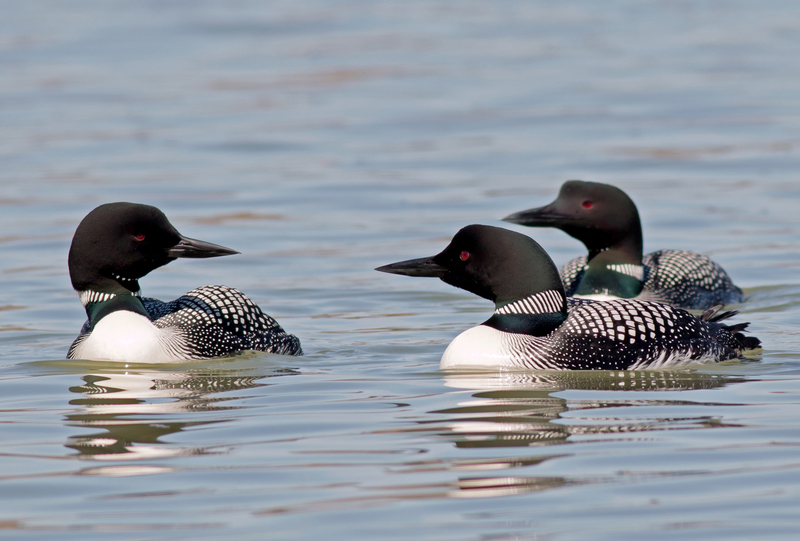
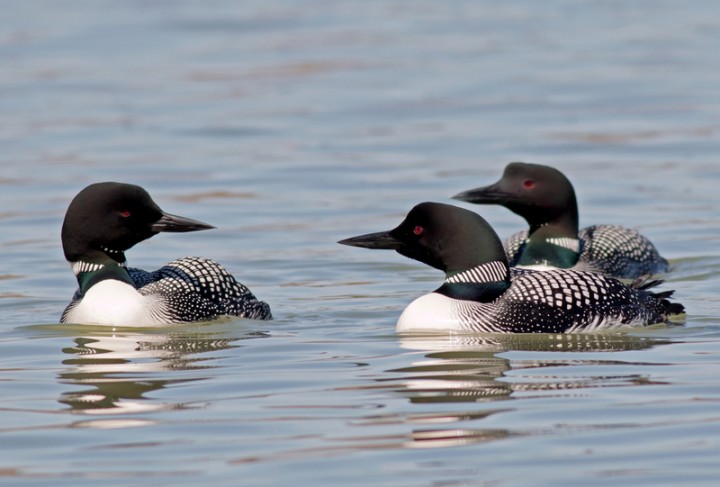
I see nothing at first, then–stark, silhouetted against the mist–a long, tapered bill. The rest of the loon forms around it. The bill connects to a dark, rounded head. I follow its curve to a necklace of white vertical stripes, then out along the loon’s distinctive white-on-black moire wings. There it is, on the nest, post-downpour, safe.
In the dozen years we’ve lived by this pond in the southern foothills of New Hampshire’s White Mountains, we’ve had loons only as visitors. Until now, none have stayed.
Susie Burbidge, field biologist with the Loon Preservation Committee, the nonprofit that monitors New Hampshire’s loons, drives up in the afternoon. She crouches on the dock, setting up her spotting scope. The fog has long since burned off. We look straight into the nest; the pair has built it well. She says our pond–30 acres at best–may be the smallest in the state hosting a nesting pair. It’s ridiculous, but I feel proud.
Even before these two touched down here, I’d been learning about loons in New England. So I know that they’re mysteriously disappearing from lakes where we should expect to find them–in fact, from the very center of their celebrated recovery. Their decline has ramifications far beyond the small world of loon watchers.
 In the language of wildlife biology, the common loon is an indicator species. Loons spend winters along the saltwater coast and breed on freshwater lakes, absorbing what has accumulated below them in two food chains. Their set of nesting requirements is narrow: They need clear, clean water; abundant fish stocks; and undisturbed areas in which to raise their young. They’re sensitive to industrial inputs and human activity. Their survival as a species depends on a web of healthy infrastructures–and may say something crucial about the health of the planet. I take their survival personally.
I’d wanted the pair to nest on our pond. Now I want their two eggs to hatch, the chicks to grow and fledge. I want to hear their drawn-out, parting wails as the trees turn orange and yellow, and the laughing tremolos of their return after the ice goes out next year. I want to see another nest built off the point next June. I want proof right here, outside our front door, and contrary to growing evidence, that northern lakes and coastlines remain healthy–that at least in some places we’re not fouling our own nests.
Loons are ancient birds. Near the end of the Cretaceous period, ancestral loons moved from land onto the oceans to exploit an ecological niche: Warm-blooded, they could expend more aerobic energy than the fish on which they preyed. “I pity the fish,” says evolutionary biologist James Paruk, “that first met a diving bird.”
Unlike their cousins, the penguins, loons kept the ability to fly. But they also adapted to their marine environments, and to diving for their dinners. Their bones grew nearly solid; they could expel nearly all the air from their lungs, allowing them to stay underwater for many minutes in pursuit of prey. I’ve seen loons chasing fish in shallow water and have been reminded not so much of submarines as of torpedoes.
Successful but highly specialized, loons ended up occupying a lone evolutionary limb. Roughly 50 million years ago, the five species of loons branched off from their nearest genetic relatives, a group that includes albatrosses. More recently, geologically speaking–several million years ago–retreating glaciers filled freshwater lakes across northern North America. Fish followed, and loons followed the fish. On lakes, adult loons faced few natural predators. They developed a migratory pattern that endures to this day: breeding on fresh water, wintering on the ocean, returning year after year to the same territories.
I dwell on their evolution because recent DNA sampling has revealed a striking lack of genetic diversity among common loons, suggesting that they squeezed through a genetic bottleneck around 10,000 years ago. This ancient species that has adapted so long and so well is vulnerable to a single large-scale event–and even to incremental changes in its environment.
When humans appeared on the North American continent, loons were there. Native Americans made a totem of the bird; to be called “loon-hearted” honored that person’s courage and wisdom. Native stories described mystical connections between loons and human beings. In an Ojibwa creation story, Loon was the very voice of the Creator in spirit form. Loon loved the first man and saved him from drowning, an act of generosity that allowed the human species to survive.
All but 1 percent of the world population of common loons breed in North America, most of them in Canada. They’re birds of the North American Far North.
“Far North” once extended farther south into the United States. European settlers reported loons throughout New England, down into Pennsylvania, and across the Midwest. In the mid-1800s, Henry David Thoreau studied loons on Walden Pond. He called their wails “perhaps the wildest sound that is ever heard here.” But fishermen didn’t see a mystical symbol when they saw loons–they saw competition. A family of four loons may eat 900 pounds of fish over a breeding season. A century ago, anglers arriving at Northeastern lakes routinely began their fishing trips by shooting every loon in sight.
The places that appealed to loons appealed to people, too, especially as we sought out lakes for recreation. But while we say that the presence of loons is a sign of a pristine environment, from a loon’s perspective our presence is the sign of a degraded one. On lake after lake in the southern part of their range, people would arrive, and loons would leave.
By the 1950s, the cry of the loon hadn’t been heard in Connecticut, Rhode Island, or Massachusetts for nearly a century. The southern edge of its breeding range crept across the borders of New Hampshire and Vermont and continued northward. Some wildlife experts were already conceding the loss of loons everywhere in New England outside of Maine. The Ojibwa story might now be told in reverse: Loons were going to survive in New England only with the help of human beings.
The man who would save New England’s loons was born at a time of profound, sometimes violent, extremes in American attitudes about wildlife. When Rawson Wood was born into a prominent New York family in 1908, the nation’s first federal bird reservations, which would form the basis of the National Wildlife Refuge system, had been established by President Theodore Roosevelt five years earlier, and interstate trade in the decorative plumage of protected birds had been outlawed for nearly a decade. Yet the “Feather Wars” persisted: Hunters illegally slaughtered hundreds of thousands of birds each year, along with the stray ranger or conservationist who got in their way.
Wood’s fate and that of loons would intersect at a singular place: Squam Lake in central New Hampshire. Wood’s family summered on these island-filled bays and coves, spread seven miles along the corrugated southern edge of the Great Northern Forest. The lake’s summer residents practiced a privileged restraint–bringing their maids, cooks, and handymen with them, perhaps, but also building their rough-pine camps back from shore and hidden from view. The lake’s wild feel was part of its appeal, and a part of that wildness was seeing and hearing those ancient birds.
Squam’s summer residents had founded the country’s first formal lake association in 1904, pledging to protect the area from “pollution and misuse.” Frustrated by varying water levels that flooded their cottages or dry-docked their boats, association members threw in some money and bought the downstream dam–and in so doing stabilized water levels for nesting loons. They used their money to block any hint of development, whether a new hotel or a public boat launch, and coincidentally conserved long stretches of shoreline. Families returned to the lake year after year, over generations, fiercely protecting their territory. Their self-interest had the effect of protecting prime loon habitat.
But it wasn’t enough. In time, Wood started bringing his own five children to Squam and noticed fewer loons on the lake. In the 1960s he tried to do something about it; he wrote to state officials, headed up the lake association’s conservation committee, became active in the Audubon Society of New Hampshire. When a speeding motorcraft ran down two loon chicks, Wood paid to print posters and leaflets promoting boating safety.
Despite his efforts, Squam’s loon population continued to slip. In 1975, Wood hired a biologist to conduct the first-ever full-season field study of loons on Squam and nearby Lake Winnipesaukee. The study quantified Wood’s fears: Loons on Squam successfully fledged just three chicks; on Winnipesaukee, only one chick survived the summer.
That same year, in a story that has the polish of legend among loon people, Rawson Wood stood to his full six-foot-plus height at an Audubon board meeting and announced that he was forming a committee for the preservation of loons. The committee would be self-funded, and he would chair it. He sat down, and that was that.
Wood’s vision of the Loon Preservation Committee (LPC) was simple and audacious. The new organization would concentrate solely on loons. It would count every adult, every nest, and every chick on Squam and on every other lake in New Hampshire. It would collect data on those loons. And it would use those data to learn how to protect them.
This combination of broad-based science and intensive on-the-ground management was refined on Squam. Field biologists funded out of Wood’s deep khaki pockets determined that raccoons, drawn by garbage bins and roadside trash, were robbing eggs from shoreline nests. Wood sent a worker to help build log rafts, four feet on a side. LPC crews covered them with soil and vegetation and anchored them offshore, out of raccoon reach. Loons adopted the floating nests. Chicks hatched–and this type of successful human intervention was picked up by other organizations.
Wood marshaled longtime summer residents around the lake to adopt loons in particular coves or bays. Feeling connected to “their” loons, people gave money to Wood’s organization. They put up signs and formed floating armadas to protect newly hatched chicks on busy weekends.
Drawing on the data collected by the new organization, the state of New Hampshire added the common loon to its list of threatened species in 1979.
Wood’s Mercedes, sporting a LOONS license plate, became a familiar sight around the lake. His summer place was located near the spot where film crews shot On Golden Pond, which opens with Katharine Hepburn’s quavering call to Henry Fonda, playing her irascible husband: “Norman … the loons! The loons! They’re welcoming us back.” In the movie, loons serve as metaphors for home and family, what we hold onto, what slips away. (“I don’t hear a thing,” grumbles Norman.) After the film’s release, a Wall Street Journal reporter noted the growing association of loons with exclusivity and access to unspoiled places like Squam. Loons, he wrote, had become “a totem to the wealthy.”
Field biologists returned every year to Squam and other lakes in New Hampshire. Gradually, counts ticked upward. The data they collected, by 2010 spanning 35 years, became the most extensive ever assembled on loons.
The research expanded beyond Squam and beyond New Hampshire. In 1987, Wood and his biologists began working with a young veterinarian at Tufts, Mark Pokras. Pokras sliced open the stomach of the first dead loon LPC sent him and found fishing tackle lodged there. The steel hook could have disintegrated over time, but the sinker, made of soft lead, had poisoned the bird.
Pokras began keeping his own records, which would grow to more than 1,500 loon necropsies. Of the adults that came to him off the summer breeding grounds, lead had killed half.
Wood and the committee took their findings to the state. After years of being lobbied, in 2000 New Hampshire’s legislature banned the sale and use of lead sinkers weighing one ounce or less and jigs under one inch. The law was the first in the nation to restrict lead fishing gear.
In time, mining decades of data, loon biologists developed a single number for indexing population stability: the ratio of surviving chicks to territorial pairs. A ratio of 0.48 meant that a population on a given lake, or in a given region, was stable. A higher number signaled an expanding population; a lower number warned of a population in decline.
Entering the new century, Squam’s loon population appeared healthy. Across New Hampshire, the number of nesting loon pairs had tripled. Only once in 25 years had the statewide breeding ratio dipped significantly below the magic 0.48 indicator. The Loon Preservation Committee had shown that it was possible to reverse the decline of a threatened species.
The success of LPC’s model was startlingly clear across the Connecticut River, where the Vermont Loon Recovery Project took citizen science to new levels. Eric Hanson, the project’s lone biologist, mobilized a volunteer army that exceeded the number of lakes in the state–about 100–considered suitable for loons. More rafts, more float lines protecting nest sites, and more lake-association meetings translated into breeding success. In 1983, only seven pairs of loons had nested in the entire state; by 2005, the year Vermont removed loons from its endangered-species list, 53 nesting pairs had produced 57 surviving chicks. The following year, when a recent state ban on the sale of half-ounce lead sinkers took effect, the number of adult loons in Vermont passed 200.
Loons were slowly recolonizing southern New England, as well. A single pair discovered at Quabbin Reservoir in 1975 grew into a population of 50 adults on a dozen Massachusetts lakes three decades later. Residents reported occasional sightings in Connecticut. Across the country’s northern tier, states and volunteer organizations drew on what Wood’s group had learned from loons on Squam.
The rafts were working. The education was working. Rawson Wood, in his 90s emeritus director of LPC, was still working. The loon–symbol of wild northern places, of the wealthy elite, of successful science–remained on New Hampshire’s threatened-species list, but the talk was of a species that had re-established itself across the southern part of its range. With the help of people like Rawson Wood, it appeared to be on the way to recovery.
The Fourth of July holiday arrives. Any day now, the eggs should hatch. I’ve been keeping anxious watch, checking on the nest each morning and throughout the day. Every time I look out, a loon is there. The constancy of the sitting–in rain, in wind, in heat–strikes me as real work.
“There are no single parents among loons,” Eric Hanson had told me. But it’s looking to me as if the male is getting stuck with all the nest duty, while the female floats and fishes in the open water off the grassy point. The male seems to think so, too, because he occasionally yodels with no predator in sight, no eagle or small airplane passing overhead. (That piercing yodel, plus his greater size, distinguishes the male from the female.) This guy, to my anthropomorphizing ear, is clearly directing his complaints to his mate: Hey! I’ve been on this lumpy bed of reeds for six hours. Your turn with the eggs!
For a time, we called the male “the intruder.” The female had first arrived on the pond in the company of a smaller mate, and we’d initially attached our hopes to that pair. Then the larger male intruded on their idyll. I saw the two males face off: They peered and dipped, rose up, spread their wings, and thrust out their chests, the white flashing in the sun. It appeared at first to be a graceful pas de deux, but the movements were no dance.
Having taken the smaller bird’s measure in this way, the intruder set about taking his territory. They wing-rowed back and forth in a high-speed chase across and around the pond, wheeling and churning over the surface. Throughout the afternoon, each time the smaller bird slowed, the intruder pounced.
Eventually too tired to continue fleeing, the smaller male turned to fight. The two birds locked bills. They pummeled each other with powerful wings, each hit sounding like a fist finding bone. Again and again, the bigger bird grabbed hold of the other’s neck and pulled him underwater.
With darkness coming on, eight hours after the confrontation began, they disappeared beneath the surface one last time. Only the bigger male reappeared.
We hoped the little male would somehow survive, but the numbers are brutal: In 40 percent of such territorial battles, the defending male is killed. (Females wage territorial battles, as well, but rarely to the death.) A few minutes later, the big male and the female were swimming placidly side by side, looking for all the world like a couple.
People once thought loons mated for life because they’d see two adult birds on the same nest site year after year. But banding and field observations have shown that those adults aren’t necessarily the same pair. In the loon hierarchy, territory comes before mate. A loon that lives its full span of 20 to 30 years might raise a dozen chicks, but only if it’s strong and determined enough to defend its territory.
By the Fourth of July, I’ve been won over by the big male. I see him on the nest and see persistence, along with the strength and size, and perhaps also a wisdom born of experience. Now I call the female “the flighty young thing.” When the male yodels at her, I swear I see her toss her head and glide away.
On the last day of the holiday weekend, I hear a call of alarm from the pond. I run down to the dock. The male continues wailing. The female hovers close to the nest. He’s getting his break at last, I think, lowering the binoculars. Something catches my eye, and I raise the glasses just in time to see a fuzzy black chick the size and shape of a Ping-Pong ball tumble from the nest into the water.
I yell up to the house and Jim comes running down. “We have a chick!” I tell him. “We?” he asks.
I’m floating, along with the new parents. But I notice that they aren’t returning to the second egg. By the end of the day, it’s clear they’ve abandoned it. (The next day, Susie Burbidge will collect the egg for possible testing.) There will be no second chick.
That night, more wails and yodels jolt me out of bed. I stand at the open window, straining to hear. A lone bullfrog booms, then a whole chorus. I wonder, Do they eat loon chicks? I suddenly, viscerally, feel all the dangers ahead, the snapping turtles, bald eagles, lead fishing tackle. Three months before that little ball of fluff can feed itself fully, can fly.
Somewhere out in the dark, the loons are trying to protect their chick. I think, Your care is what stands between your baby and death. No one–nothing–will care as much as you do whether it survives or thrives. It occurs to me that a loon’s drive to establish territory is a proxy for the real attachment: The crucial bond is between the pair and their offspring. Loons fight for the chance to be parents. They stay together for the children.
The good news from our little pond masks troubling, even drastic, recent declines on some of the region’s biggest and wildest North Country lakes: Moosehead, Rangeley, Winnipesaukee, and, especially, Squam, for so many years North America’s poster lake for loons. The crisis seemed to come in the night, and it followed no logic.
On Squam, nesting pairs left the lake at the end of one successful breeding season and didn’t return the next. The loss of seven pairs from 2004 to 2005 represented nearly half of Squam’s breeding loons and reduced the lake’s overall population to the level of 30 years earlier, when Rawson Wood organized LPC’s first field season.
The problems quickly spread down the generations. In 2003, 15 chicks had survived on Squam to the end of the summer. Two years later, only four fledged; the next year only three. In 2007, a single chick survived. LPC staffers had to sift through their records all the way back to 1978 to find a year when Squam’s famous waters had produced only one chick.
Other big lakes charted similar perplexing declines. Umbagog, a sprawling lake in forested northern New Hampshire and extending into Maine, had claimed the highest concentration of nesting loons in the state. No chicks hatched there in 2007. In Maine, where an estimated 4,000 adult loons make up the largest population in the Northeast, biologists from the BioDiversity Research Institute (BRI) found that reproductive success had tanked in most breeding areas, from Down East to the Rangeley Lakes.
Lab results on Squam eggs from the worst years of the decline, 2005 through 2007, showed surprising spikes in several toxic chemicals, including high levels of two “legacy contaminants”: PCBs, which had been banned from manufacturing in 1979, and chlordane, a pesticide banned in 1988. Newer toxins, such as those found in the stain repellant PFOS and the flame retardant PBDE-99, also appeared well above levels known to affect birds.
The questions were baffling. Was some unseen “point source” of these toxins leaking into Squam? In Maine, Dave Evers, head of BRI, worried about the effect on loons of toxic cyanobacteria “blooms.” Beyond toxins, were smallmouth bass outcompeting perch, the loons’ preferred freshwater prey? What was the effect of recent extreme weather patterns: unusually raw springs and unusually wet summers? Why had the declines disproportionately affected the large lakes? In the years since the 2007 low-water mark, the populations on those lakes had recovered only slightly. How significant were the lab results, given all the factors that historically affect loon nesting? Was it possible that chemicals in the air and water, perhaps in combination with a changing climate, were incrementally, invisibly changing the very ecology of freshwater lakes?
Researchers around New England had more leads than money, no results that definitively fingered a single culprit, but LPC’s executive director, Harry Vogel, spoke of a shared, sinking sense that their work could be touching the edges of a much bigger crisis. If loons were failing on Squam, despite a longer history of successful intervention than anywhere else on the planet, then loons all across New England, and perhaps beyond, were in peril.
There was at least one other place to look for answers. Loon biologists, almost to a person, are freshwater biologists; not surprisingly, their research focuses on the birds’ summer breeding grounds. In the last decade, however, pioneering banding and transmitter work has helped researchers determine that New England’s loons are true Yankees, moving between northern lakes in the summer and the frigid ocean between Maine and Rhode Island in the winter. Quietly floating offshore, with dull-gray plumage in place of their distinctive white-and-black, wintering loons are difficult to observe. Biologists know little about their life on the ocean.
Paul Spitzer was one of the few researchers looking there for clues. He had long studied osprey colonies on Long Island Sound and had been stunned by recent precipitous declines in those colonies to levels even below the DDT era. Spitzer had observed an equally dramatic fall-off in populations of wintering loons in Chesapeake Bay and off the coast of North Carolina. Rafts of migrating loons that had once numbered above a thousand birds had dwindled to less than a hundred. He speculated that osprey and loons, both fish-eating birds, might be reacting to the collapse in the population of menhaden, a once-prolific, small, silvery fish related to herrings and alewives, and an important part of the birds’ winter diet. His work in the Mid-Atlantic raised the possibility that a similar loss of forage fish fit somewhere into the New England loon puzzle.
While the picture on the wintering grounds remained murky, two separate events off the New England coast would reveal hard, clear numbers. During a winter storm in 1996, the barge North Cape ran aground off Rhode Island. Some 828,000 gallons of home heating oil leaked in large underwater plumes into Block Island Sound. Following the spill, 400 dead loons were recovered. Seven years later, an oil spill in Buzzard’s Bay killed more than 200 loons as they flocked up for spring migration. Knowing what we know now, it’s probable that most of them, perhaps all, had flown to the ocean from lakes across New England.
In the aftermath of the Buzzard’s Bay spill, several organizations around the Northeast, including LPC, BRI, and Vermont’s Loon Recovery Project, filed a joint request for damages that might support their recovery work. Eight years on, the wheels of compensatory justice have yet to grind out a settlement. At the end of 2010, $6 million was awarded to mitigate fouled shoreline habitat. “Loons are still in the queue,” says Vogel.
Meanwhile, loon groups across the region were feeling the pinch of the recession, their shoestrings pulled about as tight as they could go. In Vermont, Eric Hanson went to halftime, five months a year; no longer able to afford the insurance, he sold the project’s only boat.
Then during the spring and into the summer of 2010, crude oil poured from the destroyed Deepwater Horizon drilling rig off the coast of Louisiana. Similar to the North Cape spill, much of the oil spread out in deep underwater plumes. The spill began just after breeding loons had left for their summer grounds, sending shockwaves through the community of loon researchers, even 2,000 miles away in New England. BRI’s Dave Evers was called in to assess the spill’s injury to birds. Susie Burbidge cleaned oiled birds on the Gulf before starting the summer field season with LPC. Eventually more than 200 million gallons escaped the blown-out well, the largest offshore oil spill in U.S. history. Capped in July, the well was permanently sealed in September, just as loons across North America were beginning their fall migrations. Most of them–roughly 70 percent of the world’s common loons–were headed to the Atlantic and the Gulf of Mexico.
By fall, we’re calling the young loon “the juvenile.” Bigger than its mother and almost certainly a male, he badgers his parents for food. Nighttime temperatures dip toward freezing. We close the windows and add blankets to the beds. One morning in early October, I walk down to the pond with our son, scan the water, and realize that the adults have gone.
Our juvenile sulks, or so it looks to me, off in a far corner of the pond. His task now is to make the transition from water to air and to find his way to the coast. Over the next weeks, we see him struggle a few times and get briefly airborne, only to drift back to the water. It must be hard to develop the strength–and possibly the nerve, too–that will lift you away from all you’ve ever known.
The days grow shorter and colder. Our daughter catches me on the dock one afternoon, yelling across the pond at the young loon, “Get out of here!”
At the end of the 2010 field season, I’d spoken to Tiffany Grade, LPC’s field biologist for Squam Lake. Squam nests had again failed, one after the other. What most bothered her, she said, was one particular–and preventable–death. A male with a chick had been captured for banding and routine testing and was discovered to have elevated levels of lead. Attempts to recapture the male proved unsuccessful. A territorial battle ended with the weakened male beached on shore, and its chick, hatched the day before ours, killed by the attacking loon.
At Tufts, Mark Pokras performed a necropsy on the dead adult and found a fishing jig, made of lead, legal size. “That lead jig killed two loons,” Grade said.
In the end, only two chicks survived to fledge on the big lake. Elsewhere around the state, results were slightly better. But on Squam, once again, every individual mattered.
After each loon census now, Grade would call Rawson Wood at his home in Sanibel, Florida, to give him the numbers. Wood was over 100 years old and could no longer make the trip to Squam, but he still wanted to know how the loons were doing. Just a few miles from where he took the call, sandy beaches led down to the Gulf of Mexico.
Wood thanked Grade for the update. He told her that it had brought back so many memories. For that moment, he said, he could “still hear the loons.”
In early December, I wake to a grim scene: our pond frozen over, the young loon paddling far out from shore in a tiny black hole of open water. A short time later, I look out from our bedroom window and no longer see him there. Feeling heavy, almost resigned, I scan the surface. After so long, I wonder, is this how the story ends? I finally spot him, 50 yards away, motionless on the ice.
It is, I’m afraid, the beginning of the end. Deep mysteries remain about loons and their survival, but certain things are known, and the likely fate of a loon lying motionless on December ice is one of them. The knowledge saddens me, and makes me think about other things that researchers know, the measures that could be taken to save them.
Mark Pokras had told me that if you remove mortality due to lead poisoning–eliminate just that one factor–the loon survival ratio reaches the magic 0.48. Eliminate lead in fishing tackle, and get boaters to travel at no-wake speeds near nesting and brood areas, and–despite the dizzying environmental complexities–the New England loon population hits carrying capacity.
If loons are to survive the territorial battle taking place right now at the southern edge of their range, it will be human beings who must adapt. Harry Vogel points out that loons can successfully raise families on developed lakes–but the more our lakes stray from their original wild condition, he says, the more intensive the management required.
It’s an ironic truth: If having wildness in our lives is important, if we want to continue to hear the Far North cry of the loon across southern New England, we must intervene.
Let nature take its course, a neighbor had told me, as I watched the ice come in. But whose nature? I think of the young loon’s parents, all they’d invested in their offspring. I see one chance to help, and it energizes me.
Jim and I launch a canoe from the nearest shore. Breaking thin ice ahead of us with our paddles, we lever and pole and slowly slide through the water. As we approach, the loon rallies briefly, then lies down, curling away from the wind. Blowing snow piles up against his back. He offers little resistance as I lean over from the canoe and net him.
A few hours later, Vogel and his senior biologist examine and weigh the young bird at LPC’s Loon Center on Lake Winnipesaukee. Vogel feels along his keel and isn’t surprised to discover his flight muscles underdeveloped, the bird seriously underweight. The senior biologist places a U.S. Fish & Wildlife band around one leg, then drives him to a rehabilitator in Maine.
Five days later, healthy after being treated for tapeworm and frostbite, the loon makes one last trip with the help of people. The rehabilitator carries him in her arms down a long boardwalk and releases him into a protected cove along the southern Maine coast. The loon lingers for a brief moment. Then he rides the swells out into the bay, carrying the weight of two species, stretches his wings, and dives into the dark water.
Save the date! The annual Loon Festival at The Loon Center in Moultonborough, NH, is set for July 21 this year. Details on the event and more on the work of the Loon Preservation Committee at: 603-476-5666; loon.org. View Judy Lombardi’s slide show of stunning loon photos.
