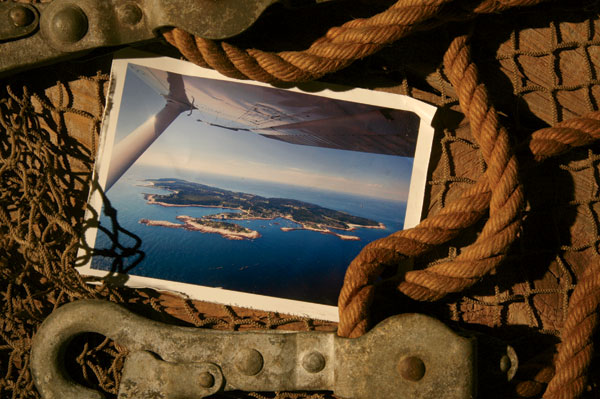
Matinicus Island lies 23 miles out to sea, the most remote inhabited island on the Atlantic seaboard. Its unique culture has been little understood by the outside world. When a moment of violence “crossed a line that had never been crossed before,” the islanders were caught between a precious past and a precarious future.Matinicus Island Photo Credit : Mindell, Doug
Vance Bunker turned 70 this year, a large, grizzled man with broad shoulders, ham-size hands, and a weathered face. He’s hard of hearing and walks arthritically. Once, nearly 20 years ago,he was the captain of a lobster boat,the Jan-Ellen, that pulled three doomed tugboat sailors out of a January sea on a night when the storm swells were eight feet high and the wind chill was 50 below. Medals followed, and media stories, a standing ovation on the floor of the Maine State House, a citation in the Congressional Record. For 17 years after that night-and more than 30 years before it-he was a lobsterman on Matinicus Island: one of its most esteemed, remembered by some for his cussedness, by others for the size of his hauls, and by at least a few for the sick children he sometimes flew, in his private plane, to medical care on the mainland. (“[He] was my personal hero,” blogged journalist Crash Barry, a former Matinicus lobster-boat sternman. “A gentle, funny giant … He drove a boat like it was an extension of his body … Kind and generous, tough and strong …”)
Today, two years after putting a bullet into the neck of another lobsterman, in defense, he says, of his daughter, Vance Bunker is a pariah on the island: legally acquitted but privately unforgiven, widely but quietly reviled. Although he still does business on Matinicus and hauls traps in its waters, he lives year-round on the mainland now, his island home of 30 years up for sale, his life there — a lifetime — now behind him. He says he isn’t angry, but it’s hard to believe him, and his wife says no such thing. Even the few who defend him, including parents who recall what he did for their children, are too fearful of their neighbors to say so publicly.
And it doesn’t end with him. Three families have been fractured. A man is partially paralyzed. Old wounds have deepened. A fragile, prized way of life, unchanged for generations, has never seemed more in peril. And on this little island, where a brooding sort of silence has settled over things, it’s hard to find anyone who doesn’t fear for the future.
“A saddening has happened here,” Suzanne Rankin says. “It’s happened to me, to the island–it’s happened to us all. We’re living it, every one of us, every single day. Vance and S.T. [Vance Bunker’s wife, Sari] don’t see that, I don’t think. How could they possibly, with all their troubles? My heart goes out to them–but they don’t see it at all.”
Rankin lives, with her husband, Tom, in a 200-year-old farmhouse along a gravel road, the only through road here, midway between the school and the church. She’s in her late sixties, an attractive, courtly woman with frosted gray hair and blue, intelligent eyes. Though not born here herself-she arrived with Tom less than 30 years ago, which makes her almost an interloper by the island’s way of seeing things-she can trace her own ancestry here back nearly to the settlement’s beginning: to Phebe Young, who came with her husband in 1763. She is the island’s historian, the clerk-secretary of its church, and a member of its school board. Her devotion to the place seems almost ingrown.
It’s the same with everyone here. You almost have to be devoted to choose to live in such a place: some 15 miles off the coast (23 miles by ferry from Rockland); no year-round stores, or bars or eateries, or doctors or policemen or paved roads, and only one industry; where the fog drops around you like a curtain for days at a time, the same three families have been fighting the same fights for 200 years, and the ferry comes once a month in winter. As the natives are fond of saying: You live here because you love it, or you don’t live here at all.
But lately, since that July morning two years ago, when Vance Bunker shot Chris Young-and the island’s clan-based, sometimes brutish culture was suddenly the stuff of cable-TV news–the islanders’ devotion, while no less total, has stiffened and turned fearful.
“A line has been crossed that was never crossed before,” Suzanne Rankin says. “There’s no going back. The question is: Where will the next line be?”
Walking the length of the island–two miles, an easy hour’s walk–the main thing you feel is the stillness. Even on the softest, sunniest midsummer afternoon, with a stiff little breeze and the lupines in full color on either side of the road–the way it was the day I first walked it–there’s something desolate about the place. The gravel road, the island’s spine, runs its dusty, almost unbending course through the old-growth spruce interior: from the tiny dirt airstrip in its clearing at the northern tip (shorter by 50 feet at high tide, they say), past the empty church and schoolhouse, the sad little pile-of-stones monument to the island’s first white settler, Ebenezer Hall (“Killed by Indians, June 6, 1757”), and the two dozen or so hardy, mostly modest homes that cluster at uncertain intervals at the intersections of dirt side roads. The day I walked it, the only movement I saw was a woman feeding an animal at her back door.
The yards are large and flat; a few have small gardens. In many of the rest, scores of green or yellow lobster traps are stacked head-high, sometimes alongside the scraped-clean hulk of an old boat or dory. Fish crates, firewood, and rope coils are piled about. Lobster buoys hang like Christmas balls from the branches of a spruce. Old pickups sit in driveways, their six-year-old license plates bearing witness to their last presence on the mainland–which some here call “America.”
A mile and a half down, past all but the last of the houses, where the island starts to narrow and you begin to think you can smell the ocean again, you come to the cemetery. It’s larger than you’d expect, and more formal: probably two or three acres, a fenced-off square of grass and old granite, with its tiers of headstones–several hundred–giving way to a small, shaded bench in the rear. The dates begin in the early 1800s, though most are later, between 1850 and 1910, growing fewer with each decade after that. Some of the newer stones are engraved with a lobster boat.
More than half the graves belong to the same eight or nine families, the island’s anchor names, which I’d come to know by this time: Ames, Young, Philbrook–the three surviving “alpha families,” as one islander calls them–as well as Hall, Condon, Bunker, Tolman, Crie. Not all are grouped together; a cluster of Condons might be resting in a corner among Youngs. It’s hard to guess what order was applied.
“There’s a sense of history here like nowhere else,” a lobsterman’s wife, Lisa Twombley-Hussey, had said to me weeks before. As a child, she spent her summers on this island and now has returned here with her family. “It’s all around us, layers and layers of it. ‘This is Aunt Belle’s house,’ [someone will say]. ‘She was a Ripley, she had a store here once, she was married to an Ames.’ It goes on and on: this person, that house, this husband, that wife. Memories, connections, personal histories. All those generations. It’s always been that way here. You don’t see that other places. Not anymore, anyway.”
The shooting happened over lobster traps: who has a right to them, and where. But the deeper causes had more to do with other things: pride, greed, progress, family, what it means to claim a place as home.
Matinicus is one of a vast necklace of islands, more than 3,000 in all, spread out along the Maine coast as far north as the Bay of Fundy. A century ago, 200 or more of them were fishermen’s communities; today, only 14 are inhabited year-round. Of those, Matinicus is the most seaward, and the most indigenous. It is also, by an accident of topography–its distance from the mainland, which makes for less freshwater runoff, plus the mix of shoals and deepwater channels that surround it–the site of the richest lobster grounds on earth. “They’re the best there is, hands down,” says Marty Malloy, who’s been buying lobsters for a living since he got out of the Navy 10 years ago. “There’s no runoff, the water’s colder, the trenches are deep around the island. If I’m buying for my own table, I guarantee you, they’re going to come from Matinicus.”
There was a time when that wouldn’t have mattered much; 50 or 60 years ago, with an island population just shy of 200, there were other ways to make a living here. You could row out in the harbor and catch as many cod as you wanted; there were cattle here then, and horses, geese, and pigs. A few families raised potatoes; almost everyone had a garden. Lobstering was a tougher business in those days: The boats were slower; you couldn’t set your traps more than a few miles out from the island; and you had to haul them up by hand. Two hundred traps, maybe 250, were the most a man could manage. Enough to make a living, but never much better than that.
Then the big trawlers came, with their drag nets and sonar, and depleted the groundfish–so that was the end of that. And the land got farmed out. And the old gasoline engines got traded in for diesels; the boats were faster now, so you could set your traps twice as far out. And with the new hydraulic trap haulers, all you had to do was twist a handle and up they came. Five hundred traps was now a manageable load. Some men began to do well.
By the early 1990s, at least a few were getting rich. With the cod and haddock now gone as predators, the Maine lobster harvest had more than doubled: from 20 million pounds a year to close to 50 million. A two-man boat would come in with a three-day haul of 4,500 pounds, worth $14,000 or more. Matinicus boat owners began wintering in Florida, or buying second homes on the mainland. Some traded up to 600-horsepower diesels that could make it to Rockland in an hour or less. They began buying their groceries there–and the island store, open a century, went under. Whole families moved away entirely, but still showed up to haul their traps. It was somewhere along this cycle that the first real damage was done.
There were 188 people living on Matinicus in 1950, roughly half that 20 years later. There are probably not 35 today. The little one-room K-8 schoolhouse, viewed by just about everyone as the island’s truest pulse, has rarely had more than 10 or 12 students; in recent years the average has been more like half that. (In 2001 it had none at all, but stayed open officially–absorbing the costs required–to avert the bureaucratic death knell that closure would have meant.)
Those still left, their lobstering grounds now within range of any mainlander with a diesel engine, began drawing the lines tighter around the island–“protecting your bottom,” it was called. Threatening notes were left in bottles; trap buoys were tied with half-hitches to warn away encroachers; and sometimes, trap lines were cut.
Five years ago, a member of the Ames clan, who’d left Matinicus years before but never stopped lobstering its waters, began hiring someone else to work his traps. They warned him, then cut his traps. He responded by threatening a ramming; they put two shots across his bow.
“You have to understand: This bottom, for these guys, it’s like the family farm. It’s their legacy; they’ve been working it for generations,” says Marty Malloy, the lobster buyer, who lives on the island with his wife and twin boys. “You don’t just let someone come in and take that away from you.”
Matinicus Island Photo Credit : Mindell, Doug
More time passed; the economy soured. By the summer of 2009, the price of lobster was at a 12-year low. On Matinicus, where the lines were drawing tighter, they told Vance Bunker that his son-in-law, a mainlander, was no longer welcome to set his traps.
“It used to be you fished here, you lived here,” Clayton Philbrook says. “That was the way it worked–before the boats got fast enough so a man could live in one place and fish in another. So now we got problems. We’ve had problems ever since.”
He’s in his late fifties, a big man with thick arms, a droopy, graying mustache, and a warm but very certain way of saying things. He is descended, he tells me, from a family of shipbuilders who first settled in Bath in the 1770s, migrated to the Penobscot Bay islands, and have been on Matinicus for just under 200 years.
There was a time, Philbrook says, when he had thoughts of leaving the island: He went to college, took courses in aerospace engineering (“I thought maybe I wanted to go into space”), switched to biology, then to photography–but nothing clicked. He came home and got a job as a sternman–an assistant–on another islander’s lobster boat, then other boats after that. Thirteen years ago, he bought his own. Along the way, he married an Ames girl. (“Some people talk about family trees; what we have here is a wreath.”) Their son, Nick, now 30 years old and a captain himself, has been lobstering since he was 8.
All this Philbrook explained to me one rainy spring morning, as we sat together in the cab of his pickup, parked that day at the Matinicus dock, the site of the shooting in July 2009. His boat, the Samantha J., was tied up alongside. For most of the morning, he’d been working on the engine, but the rain was a torrent now, so we were waiting it out in the truck.
At one point as we talked, another pickup pulled up in front of us, and a woman–June Pemberton, once a teacher on the island, now one of two women to captain a lobster boat–got out and began unloading traps. Without a word, Philbrook was out of the cab, and for the next several minutes the two unloaded traps together in the rain.
Mostly, he talked about the business of lobstering: how the cost of bait and fuel had gone through the roof, while the price being paid for a pound of lobster was making it hard to get by. (“It’s cruise ships and casinos that drive the lobster market,” Marty Malloy would say to me later, “and we’re in a beer-and-salad time.”)
In 2009, Philbrook said, he’d sold more lobster than he’d ever sold before, yet barely covered his costs. “It’s hard times for everyone,” he said.
He tried his best, as they all do here, to stay clear of the subject of the shooting. But it was never far away.
He said he worried sometimes that with the way things were going, his son, Nick, could be the last Philbrook to make a living here: that if people kept leaving for the mainland and just coming back to haul lobster off the bottom (“taking and taking, and never giving back”), the island, like all those others, could die a lingering death. “And I’d do about whatever I had to do to see that doesn’t happen,” he said. “We all of us out here would.”
I asked Philbrook about the “fishhouse meetings” I’d heard about that had been going on the last several years: all the lobstermen on the island, gathering every springtime in the schoolhouse or church basement to set the rules that would govern, among other things, who could lobster and who couldn’t. There was nothing legally binding in anything they decided; a licensed lobsterman, as far as the law is concerned, can set his traps anywhere he chooses. But that was never the point.
There’s a way of doing things, Philbrook told me, and it just seemed as though the time had come to get things clear once and for all. And so they’d made it formal: “If you’re born here, you can fish here–or if you’re the child of someone who was. If you marry one of our daughters, you can usually fish here, too. And if you fish here, we want you to live here. That isn’t the law. That’s just how it works.”
It was a while before either of us mentioned Alan Miller. But there was never any doubt about whom we were talking. Miller is Vance Bunker’s son-in-law; he married Bunker’s daughter Janan several years ago, bought a house on Matinicus not long after, and had been lobstering island waters ever since. But the couple’s primary home was on the mainland; some said their island house wasn’t even winterized. There’s a name among islanders for people like that: “fuel savers.” It isn’t a good way to be known.
“He’s not a part of the community; he never has been,” Philbrook said to me. “You want to be a part of the community, put your kids in the school here, support the island, pay into it–that’s one thing. He didn’t. He rubbed people wrong. He had a bad reputation. And in the end, your reputation is all you have. Anyhow, we voted him off.”
They voted him off the island–out of island waters. He defied them: set 400 traps around Matinicus, reportedly with his father-in-law’s blessing. When half of them were cut two weeks later, he was sure he knew by whom: a pair of stepbrothers, Chris Young and Weston Ames, both in their early forties, with 400 years of island ancestry between them. So he cut theirs. Or maybe Vance Bunker cut them, or maybe both of them did, or neither; it can be foggy off Matinicus in the early mornings.
However it happened, traps were cut, tempers flared, violence was threatened. And then, at a little before 6:00 on the morning of July 20, 2009, one of the men, Chris Young, boarded Vance Bunker’s boat, accused him of cutting his traps, and, Bunker would say later, threatened to kill him. The two men wrestled. Bunker repelled Young with a can of pepper spray.
Most of this is pretty certain. A good part of the rest, including the bigger questions of background and intent, and who was right or wrong, depend mostly on whom you ask. It’s also at this stage of things that the silence sets in. Or you get your answers off the record.
“Vance and Chris getting into it, there’s nothing new there,” one islander tells me. “The Bunkers and the Youngs feuding–that goes back. It could have been something their grandfathers were fighting about.”
This from someone who recalls the days, 30 and 40 years ago, of church suppers, bingo nights, and community softball games; when times were so tight that most of the men fished year-round (the norm these days is April through December) and still went out at night with herring nets; and grudges, no matter how bitter, were nearly always trumped by need.
“I cut a few of yours [traps], you cut a few of mine–that was always going on–until the time came when somebody lost their boat or their roof blew off in a storm,” the islander says. “Then it didn’t matter if it was your worst enemy; you were there for them–because you knew you’d need the same if it was you. That’s how things are when you have to fight to survive. And we did. Now you’ve got the big fishermen with their fast boats–Alan Miller, he’s got two boats, he’s not a young guy anymore, he’s already made his money–who come in not caring about anything, just looking to fish some sweet waters.”
When Miller arrived at the Matinicus dock that morning, Ames and Young were awaiting him. So was his wife, Janan–who had seen from her window the men converging on the harbor, and had brought with her a 12-gauge shotgun she would claim she didn’t know how to use. And Vance Bunker was there; he’d arrived with his sternman in a blue pickup with a .22-caliber handgun and an AK-47 assault rifle with nine loaded magazines.
There was some shouting. At some point Janan Miller yelled “Hey!” and pointed the shotgun at the stepbrothers. “Shoot me, you stupid bitch!” Weston Ames may have said, at about the same instant he grabbed for the gun. Bunker fired his handgun and missed. His second shot hit Chris Young in the neck. He collapsed in a pool of blood at his stepbrother’s feet. He would survive: his hands mostly paralyzed, his left arm no longer of much use, his lifetime earning power reduced by $2.4 million, according to the lawsuit he would file.
“Greed, that’s what’s behind all this,” Vance Bunker would tell me months later. He wasn’t talking about the lawsuit. “It used to be, you had to work for every dollar you got. No more. Today, there’s not a lobsterman on the island under 50 who’s ever had to scrape for a living. It’s all come easy to ’em. So now they think they got a right to it. And as soon as things get a little tough, they get all pissed off and start setting up rules–about property, and family and whatever, and who can fish and who can’t–and writing them down and passing them out. Then at the next meeting, they go and change the rules.”
Matinicus Island Photo Credit : Mindell, Doug
It was mid-April of last year, a little more than a month since a jury had taken a day and a half to acquit him of all charges stemming from what had happened on the island dock that day. (“What type of father would pull the trigger?” his lawyer had put to the jurors. “The real question is What father wouldn’t?“) We were sitting together, he and I and Sari–known by most on the island as “S.T.,” short for “schoolteacher,” which is what she was when they met here more than 20 years ago–in the living room of the modest, red-shingled house they’ve shared seasonally for 17 years in a small coastal town just across the water from Matinicus.
I’d heard by now the story of his family’s early years: how his grandfather had been a rumrunner on the island during Prohibition, hiding the bottles in deepwater puddles; of his father, a lobsterman, and how he’d met Vance’s mother, who’d come there to work as a nurse; how he’d started pulling traps as a teenager and never stopped; how it used to be that when you had an argument with a neighbor, “you got over it real quick, ’cause you needed each other more than you needed to stay mad.”
Working his way around Sari’s occasional outbursts (“Yes, I’m bitter–I don’t expect my closest friends to go against my family, and do it publicly …” “Easy now, you’re getting yourself worked up …”), he’d told me his story of how it had all come to pass: how his son-in-law had played by the rules–“He married my daughter, they bought a house there”–and had still been run off the island; how he’d gone to see Chris Young’s stepfather, futilely, to try to settle the dispute; how he’d feared for his life, and later for his daughter’s (“The man threatened to kill me”); how Young’s and Ames’s civil suits, (the former settled this year, the latter still making its way through the courts) could take most of what he and Sari had; and, finally, how the island was no longer home to him, and his friends were no longer his friends. “They won’t even talk to me,” he said.
He seemed at a loss. It had all changed so fast. One day life was good: full, straight-ahead, uncomplicated. There was plenty of money, a close family, a lifetime of friendships, a job you were good at, the respect of almost everyone you knew. Things had been the same a long time. The next day, a day you couldn’t have seen coming, you back the wrong horse, play chicken with a couple of kids who aren’t 16 anymore, then pull a trigger in anger or fear. And now it’s all about “the old days” and “the way it used to be.”
“He had so much to lose,” an islander would say to me later. “He’s the last guy on the island I would have expected this from. But things were changing, and he couldn’t deal with that, I guess. I feel for him, I really do. But a bad hurt has happened. And he’s the one who brought the guns to the argument.”
Three summers ago, the summer before the shooting, the island got together and threw itself a high-school prom: men, women, and teens, many in 30-year-old tuxes or too-tight, floor-length dresses–one guy even in white tie–rocking out to “Boogie Fever” in the church basement under crepe paper and string lights, popping flashes, selling raffle tickets, drinking spiked punch from a bowl in a neighbor’s yard. You can watch it on YouTube: “Starry, Starry Night: Matinicus Prom 2008.”
Three months earlier, the island’s post office had burned down. It was the community’s heart; it had begun as a chandlery a hundred years before, and later was a general store. Every man and woman on the island showed up with an ax to clear a fire line, a shovel to dig trenches, or a box of sandwiches; old men too feeble to swing axes strapped packs on their backs and sprayed down nearby trees.
Then, in October of the same year, just two months after the prom, a young lobsterman, Chris Whitaker, went missing in the waters off Matinicus; only a boot, a lunch pail, and an oil can would ever be found. Every boat on the island, and Vance Bunker in his plane, worked the sea for days, while the island’s wives walked the shore in search of clues. (“He was no angel,” remembers Suzanne Rankin, who walked the western shore herself. “But he was one of us.”) The money raised from Prom Night would go to Whitaker’s family.
There are a thousand stories like this. Of fires, drownings, lost boats, sea rescues, church suppers, roof raisings, shared food, every neighborly act you could think of. But also of cut traps, knife fights, boat rammings, death threats, and ancient feuds.
They’re archetypes, all of them: Rugged Individualism, Frontier Justice, The Good Old Days. Just about any Matinicus story you read (and there have been dozens, especially since the shooting) is going to have you believe that it’s either a rogue outpost of inbred, gun-happy cowboys–“Pirate Island” is a common reference–or a quaint little throwback to some simpler time. “There’s a war going on in coastal Maine, where renegade crustacean gangs are forcing people to grope for their guns,” was how one national magazine painted the scene, ludicrously, late last year. And its antithesis: “An out-of-the-way summer idyll … a world apart from bustling Bar Harbor,” was a typical depiction several years ago.
There’s no war going on, and no one I met is “groping for their guns.” But other than that, there’s at least some truth to most of it. Matinicus is a remote, largely forgotten island community of defiantly independent souls. “We’ve got no use for police out here; we’re just fine policing ourselves,” one local told me. “A man drives too fast, we tell him to slow down. He don’t slow down, he wakes up one morning, looks out his window, and sees he’s got four flat tires. He drives slower after that.”
This isn’t a place that could exist on the mainland–or, probably, even 10 miles closer to it. Its remoteness accounts for much of what it is: its history, its preciousness, its peril. Probably also its future, whatever that may be.
“You have to want to be here, really want it,” Nat Hussey said to me early in my first visit. “You have to shovel the snow, sit on the school board, go to meetings, do the work–you have to share the load. There [on the mainland], when you want your car fixed, you go to the garage. Here you do it yourself, or you get a neighbor to help you. I’m forever getting helped, by this person or that. But you need to find ways to help back. If you can’t do that, or you won’t, then there’s no place for you. That’s the way we’re built here. And I’m a guy who wants to be here.”
Hussey is a lawyer in his forties, a slight man with thin features and tousled, receding brown hair. He used to work for the Maine Department of Corrections. Thirteen years ago, on his honeymoon, he came to Matinicus for the first time; his new wife, Lisa, had spent her childhood summers here. They began spending parts of their own summers. In 2005, for three days, he signed on as a third man in a lobster boat, and, he says, “a gene flipped on in my head.” He left his job; she left hers. Today he makes his living on the island, doing carpentry jobs and occasional legal work, collecting taxes, helping out at the schoolhouse, and hauling lobsters from a motorless, oak-and-cedar “peapod”-style rowboat he calls the Sweet Pea. It’s a boat no serious lobsterman has worked from in probably 60 years, but it leaves no carbon footprint, and that’s important to Hussey. On summer Saturday nights on the boat dock, Hussey and his guitar lead dance parties that turn out the whole island. On Prom Night three summers ago, he was the one in white tie.
The day we talked, a warm May day in the front yard of the couple’s island home, he’d just put his boat in the water for the season. A few yards away, alongside the traps still piled by the garage, two of the three Hussey children took turns dousing one another with a garden hose. Lisa, busy readying her Matinicus Island Store for its spring opening, just days away, came and went from the conversation. (The tiny store, launched in July 2008, lasted three seasons, but with too few patrons to cover costs, would finally close at the end of last summer.)
Out on the water, Nat said, “You’re close to your work, you’re wet, it’s noisy, it’s real, sort of like farming must have been at one time.” Lisa, for her part, talked about the silence–“You listen carefully, you hear individual things: the wind, the bell buoys, the generator at night”–and the spareness of day-to-day life: “That whole Walmart mentality, there’s none of that out here. You learn how little you need. You learn what real need is. Lots of stuff like that, stuff they lost 50 years ago on the mainland, it’s still the same way here.”
It was a long while before any of us mentioned the shooting. When Lisa finally did–she’d been talking about neighborliness and the response to the post-office fire–it was so unexpected, and came in such a half-whispered seethe, it felt almost like an eruption: “It’s such a fragile system we have here. Just so delicate. And then the fire, and the center of our community is gone, just like that. Then last year, with what happened–a man opening fire on the public dock. I got sick when they told me. Literally, physically sick.”
In the end, though, it is the island’s willfulness, more than anything else–more even than its isolation–that sets this place apart. Two hundred years’ worth of clan-based survival–six or seven generations of Youngs and Ameses and Philbrooks, and the few who have joined them–fighting, marrying, burying, and working with one another, on a 700-acre island, has built up a very thick crust.
“It’s the big dogs who’ve kept it going,” Nat Hussey says. “It’s like the way they know their bottom: The trenches and channels and rocks, they’ve known them since they were boys. They know the island the same way. It needs them, it’s always needed them. The system here relies on clans. If they died out, I don’t know where we’d be.”
You hear this a lot on the island: that the old ways are the best ways, that the surest route to the future leads through the past. It’s as though the clans in their way were a sort of monarchy: a continuum of ascendant families whose generations of canny, devoted stewardship will somehow see the way through. As a belief, it’s a hopeful, uniting force. It’s also the biggest reason why, whenever there’s an event at the school–just about any event at any time of day that involves the five or six kids there–30 people are apt to show up.
“Everyone knows that the kids are the future of the island,” Heather Wells told me when I met with her last summer. She had just finished her second and final year as the island’s teacher; her six students had ranged from kindergarten through sixth grade. We were sitting together in her schoolroom, surrounded by books, wall maps, crayons, and computer tables, talking about all the people on the island who had helped create the projects her students had shared. She told me about how, when an octogenarian member of the Ames clan had died not long before, a local writer, Eva Murray, had come to the school to talk to the children about his life, “so they’d understand something of the history of this person they’d known.” I asked about the shooting: Had she discussed it with the children? She looked at me coldly. “It doesn’t come in here,” she said, and that was the end of that.
She told me about a social-studies exhibit the islanders had planned: “Captains of Matinicus,” put together by the captains of the island’s lobster boats. “Twelve or 13 of them, I guess, came in and told stories, showed photos, shared their memories,” she said. “One of them brought in some old buoys, maybe from when he was a kid, I’m not sure, and showed us how they were made. I loved seeing that. It’s about building long-term memory–like the way farming used to be, when the kids still learned from their elders. Not like today, with computers, where the process works in reverse …
“And you know what? It works. I had two 10-year-olds this year already laying traps. There’s a strong dedication in this classroom, I can tell you that, to continuing this way of life.”
Donna Rogers is 71; she lives with her husband, Charlie, a lobsterman, in a home overlooking the harbor. She’s a painter, and in the summer also runs a small gallery she calls “The Fisherman’s Wife,” selling art, handcrafts, and notecards to the summer people. On my last day on the island, I went to see her there and bought a small, dreamy photo, taken years ago, of a rainbow over Matinicus Harbor.
She’s a little like a rainbow herself: stout and graying but full of wonderful old stories that paint pictures and cast spells. Many of them are included in the thin, typewritten, hand-stapled book she wrote a decade or so ago: Tales of Matinicus Island: History, Lore and Legend. It tells of Indians, settlers, famous storms, and old shipwrecks, as well as a long-ago girlhood of apple fights and ice-cream making and “homemade kites made of brown wrapping paper and miles of trawling line.” Nearly every home on the island has a copy.
She told me about how she’d first come to the island, as a 9-year-old girl–“a thousand years ago”–when her mother married a Young. Then she’d left, and returned again as a young wife and mother when her husband first took up hauling traps: “We’ve always had to fight to hold on to what we had, always. When Charlie first came here all those years ago, they cut his traps, too. Well, he just put more in, and they cut them again. So he put more in. He was new. He had to pay his dues. It’s what you had to do.”
Then she stopped. “But now with this …” She tilted her head back, hard, almost violently, toward the open window behind us and the dock and harbor beyond.
“Vance and I were kids together. He’s my family. All of them, everyone, the whole island–my family. So it’s hard, what’s happened. It’s very hard. It’s a break in the family …
“I don’t know what to think anymore. When Charlie and I were coming up, it was a different time. A gentler time, I guess you’d say. You had to fight then, too, but it seems like the rules were more moral. Does that make any sense? Now, with all that’s happened–I don’t know. It just seems like right and wrong mean different things today.”
All that was many months ago. The little photo I bought that day, of the rainbow over the harbor, hangs now over my desk at home. It seems almost of a different world.
It’s hard to account for why exactly. It’s more, I think, than the perfect calm of the water, or the hazy, purplish light that must have followed the rain that day. In the photo, the harbor boats seem smaller, and humbler, than I remember. They float at their moorings comfortably apart, not much more than a dozen of them, gentle neighbors under an early-evening sky. I can’t make out their engines, but I feel certain they were smaller, too–and slower, built for a lazier, more generous time.
On Matinicus Island, until that July morning two years ago, it was still that time. A fight was still just a fight, was still among family, could still be atoned for. The world across the water–“America”–had not yet quite arrived.
Now, I fear, it has.