Stephen Wood bounds over to a large tree hanging heavy with russeted fruit. “You gotta see this one–this is one wild apple.” He pulls an apple off a branch and hands it to me. It’s crisp, a bit rough-textured, and astringent, like tea from leaves left too long in the cup. It’s a Medaille d’Or, one of dozens of traditional French, British, and American apples that Wood grows at Poverty Lane Orchards in the rolling hills of Lebanon, New Hampshire, and blends into his Farnum Hill ciders.
This unusual fruit is one of dozens of varieties I’ve tasted over the past six years as I wrote the book. I’ve tasted New England natives like Roxbury Russet and Baldwin, the signature Champagne apple of New Mexico, and California’s pink-fleshed Hidden Rose. Apples are adaptable and can thrive in a wide swath of the earth’s temperate regions. In this country, they’re grown commercially in 32 states, and home orchards can be found from Alaska to Florida.
Blue Ribbon Deep-Dish Apple Pie Photo Credit : Squire Fox
But no apples taste as good to me as those grown in New England, where you’ll see remnants of former orchards in long-abandoned fields, in forests, and even in most cities. Apples are so tied to our history that when I first began my research, I half-expected to learn that the Pilgrims had found rows of Baldwin and McIntosh trees when they first stepped ashore at Plymouth.
In reality, North America’s only native apple species are crabapples. The sweet apples we associate with home and country first originated in Asia, and over time were carried west via ancient trade routes; they eventually landed in North America in the 17th century when colonizing Brits carried them along.
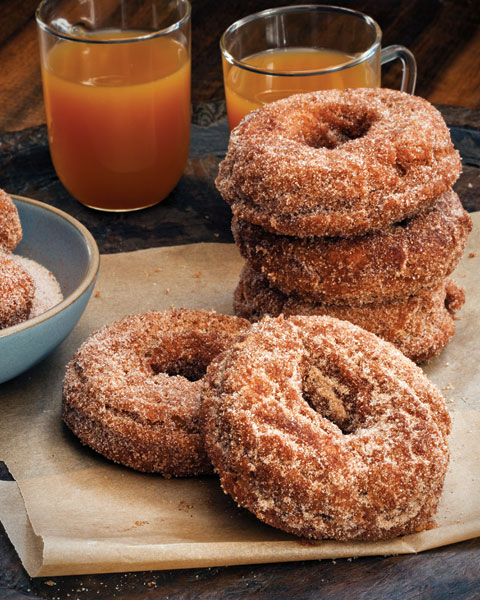
Vermont Apple Cider Doughnuts Photo Credit : Squire Fox
The first original American apple variety, a chance seedling that came to be called Blaxton’s Yellow Sweeting, sprouted up around 1625 on the property of the Rev. William Blaxton (also spelled Blackstone), the first British settler in Boston. The site of his homestead is now Beacon Hill; a memorial plaque at 50 Beacon Street honors him.
Not long after Blaxton’s success, someone–it’s not clear who–discovered a sweet, russeted, green apple growing in a field in Roxbury, south of Boston, and liked it well enough to propagate it. It became the Roxbury Russet apple, which is still in active production today.
Apple & Mustard Grilled Cheese Sandwiches Photo Credit : Squire Fox
For the early colonists, apples weren’t just a sweet table fruit. They were the source of cider vinegar, which was used in food preservation. They provided hard apple cider, and from cider came distilled ciderjack, which was used as a spirit, a preservative, and an anesthetic. Soon there were orchards lining the Eastern Seaboard as far south as northern Georgia, and apples became a staple of American cooking. By 1905, when the United States Department of Agriculture produced a catalogue of all known apple varieties grown domestically during the previous century, the total count exceeded 14,000.
Today the U.S. Apple Association says that only about 100 varieties are grown on a significant commercial scale–but apples still thrive here in New England and in other parts of the country. How many of us can experience fall without a visit to the local orchard? When you pick local fruit, you’re keeping our apple heritage alive. And then when you do return home with your bounty, you can use these recipes to make the most of this fruit, so wedded to who we are and where we come from.
Apple-Studded Brown-Butter Streusel Coffee Cake Photo Credit : Squire Fox
Amy Traverso
Food Editor Amy Traverso oversees the Yankee Magazine Food department and contributes to NewEngland.com. Amy's book, The Apple Lover's Cookbook (W.W. Norton), won an International Association of Culinary Professionals (IACP) cookbook award for the category American.