




Antiques: William Matthew Prior’s Paintings
Flat. It’s a word not often associated with beauty or talent. Rather, it conjures up far less remarkable images: flat tire; flat broke; flat as a pancake. But in the world of folk art portraiture, flatness is so desirable, even transcendent, that it practically defines the genre itself. Folk art portraiture, often called “naive” portraiture, […]

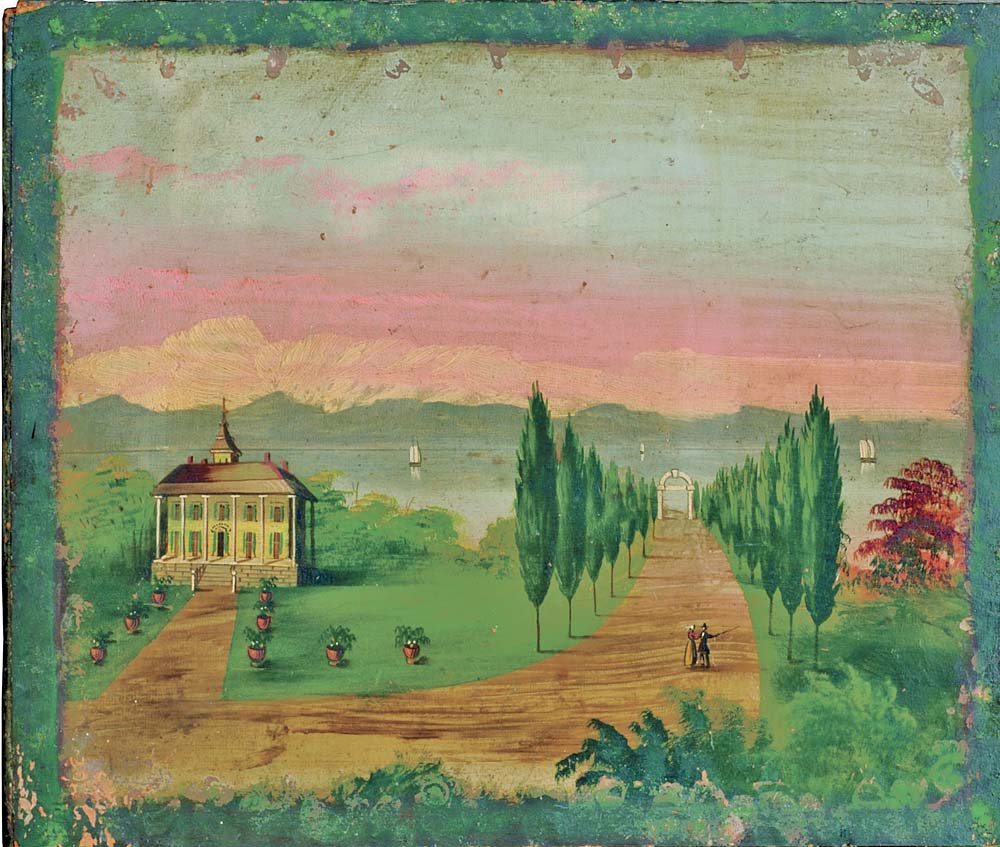
“The House That Jack Built,” an 1851 landscape, sold for $24,675 at auction this past June.
Flat. It’s a word not often associated with beauty or talent. Rather, it conjures up far less remarkable images: flat tire; flat broke; flat as a pancake. But in the world of folk art portraiture, flatness is so desirable, even transcendent, that it practically defines the genre itself.
Folk art portraiture, often called “naive” portraiture, is a subcategory of American folk art. It refers to portraits painted in a flat, primitive style with no shading, minimal perspective, and few details, often painted by persons with little or no academic training. New England is awash in examples of folk art portraiture, and some of the best are the work of William Matthew Prior, one of the most influential and prolific folk art painters of the 19th century. Skilled in everything from gilding and japanning to landscape painting and delicate eglomise work (reverse scenes painted on glass), Prior is most renowned for his flat, straightforward portraits of middle-class New Englanders.
Prior was born in Bath, Maine, in 1806, the son of a sea captain. By the age of 18, he was an accomplished painter, but no record of his formal training has ever been found. Though capable of academic portraiture, Prior’s business acumen led him to market his talents to New England’s burgeoning merchant class. In 1831, he advertised that “persons wishing for a flat picture can have a likeness without shade or shadow at one quarter the price.”
The appeal soon caught on. Prior’s quick, loose brushwork enabled him to mass-produce portraits in a simple, direct, and appealing style. He concentrated on his subjects’ facial features, while hands, feet, ears, and clothing were rendered with less definition. Most popular were his full-length portraits of children in colorful dress, often depicted with pets or toys — some pictures quite plain, others with more elaborate backgrounds. Prior’s subjects fix their gaze steadfastly on the viewer, creating a nearly ghostlike quality, at once haunting, amusing, and charming.
By 1841, Prior’s success had led him to Boston, where he established himself as one of the city’s most productive and influential painters and a prominent abolitionist. His marriage to Rosa Clark Hamblin of Portland, Maine, fostered a lifelong collaboration with the Hamblin family of painters. This creative association resulted in the further refinement of his unique style, now known as the Prior-Hamblin school of portraiture.
By 1850, however, Prior’s work as a portraitist had begun to wane owing to the growing popularity of daguerreotypes. Late in his career, he painted beautiful imaginary landscapes and historical figures, many of which now fetch tens of thousands of dollars at auction.
Today, William Matthew Prior is among the most sought-after names in American folk art. His portraits sell anywhere from a few thousand dollars up to $50,000. The flatter the picture, the better — because for true enthusiasts of this genre, Prior’s portraits lack depth but not substance. They embody a sense of weightiness that defies their two dimensions, and for all their primitive simplicity, they appeal to the most sophisticated of palates. To a folk art collector, they’re flat-out sublime.
Catherine Riedel represents Skinner Auctioneers and Appraisers of Boston. skinnerinc.com
