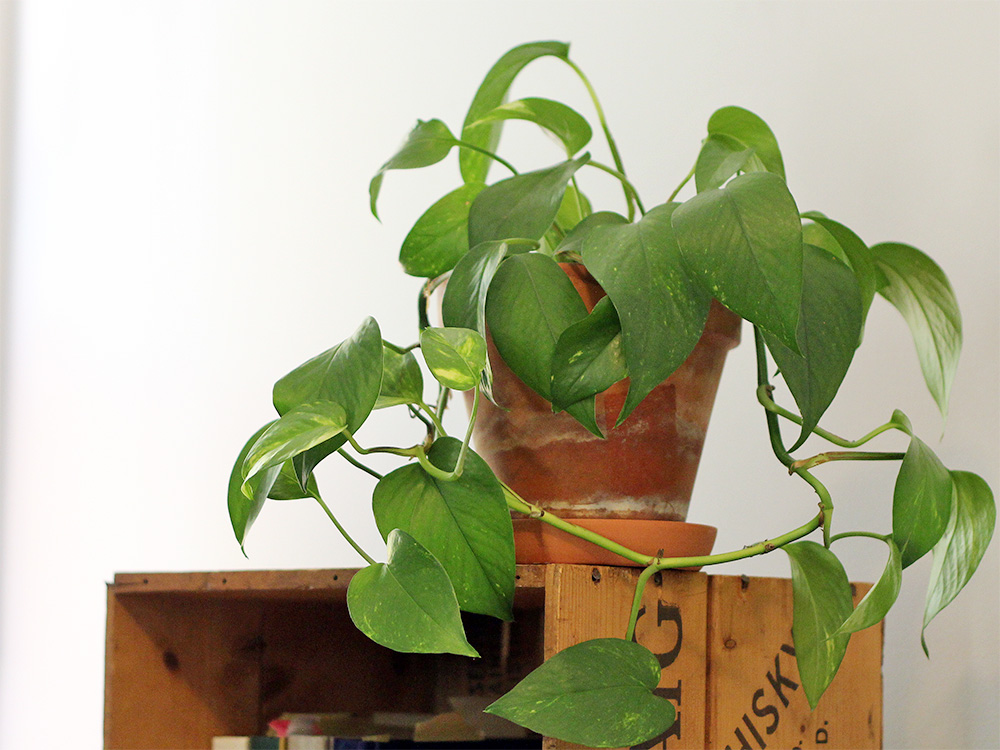
Not all plants come from seeds or bulbs. Most houseplants can be easily divided to create more plants. A few common plants that are simple to start or “root” are spider, ivy, philodendron, coleus, begonia, pothos, wandering Jew, and geraniums.
Pothos Photo Credit : Brenda Darroch
The first step in plant propagation from existing plants is to take cuttings. Plant cuttings are snips off of the appendage of a healthy plant. Hanging plants such as wandering Jews and ivy need periodic trimmings to encourage full growth, and using these cuttings is a great way to start new plants.
Before making a cut, look for nodes—these are the beginnings of new leaves and stem systems and resemble small roots or buds. A cut should always be made just below the node. Allow room for at least two inches above the node to taken. Use sharp scissors to make one clean, angled cut. Remove any remaining leaves beneath the bottom node and place the stem of the new cutting in a glass of lukewarm water. If the plant does not have visible nodes, make a cut below the last new leaf growth. Place the cuttings in a window, and before you know it, roots will begin to grow. Roots can take as little as a week to appear but may take as long as a month. While the roots grow make sure the water level in the glass remains above the roots. When a good root system is established—typically after four to six weeks—the cuttings may be placed in clean potting soil in a plant pot. Combining several cuttings in one pot will provide an instant established plant, and with in a few weeks the roots from all of the cuttings will merge together as one.
Rooting spider plants is a bit different from the stemmed plant process as cutting is not necessary. Once mature, Spider plants will sprout “babies” (several miniature plants will sprout from a long shoot of the main plant.) Once the babies have visible roots, simply twist the baby plant from its base to remove and place it in lukewarm water for a few weeks to coax the root system to grow more before it is re-potted. You can also place a pot of soil under the mature plant and allow the babies to root themselves. A grouping of baby spiders can take on the form of an established plant in no time at all.
Succulents such as hens and chicks and sedum will self-propagate and may be gently removed and re-potted when needed. To separate succulents, first look for new growth areas. New growth is found on the edges of the main plant. New growth is usually smaller in size from the original and sometimes has a slightly greener or pinkish color. Locate the separation point where the original plant and the new growth are loosely connected. Gently remove the smaller appendages by carefully pulling the plant away from the mother plant by the base using your fingers to untangle roots as you separate. Shake out the root system of the newly removed plant and transplant into a potting medium designed for succulents.
Newly rooted or divided plants require no special treatment. Regular plant maintenance such as watering, adequate lighting, and pruning of dead leaves is all that is required. Rooting plant cuttings and sharing with friends is a great way to diversify your own plant collection with out spending money. Rooted houseplants also make terrific house warming and hostess gifts, especially when paired with instructions for plant propagation.
Shelley Wigglesworth
Shelley (Fleming) Wigglesworth is an award-winning freelance journalist from Maine and a certified Maine Master Gardener who writes gardening articles on a regular basis for NewEngland.com. Her work can be found in the following publications: The Village Magazine, York County Coast Star, Yankee Magazine (online), National Fisherman Magazine, Commercial Fisheries News, Points East Magazine, Coastal Angler Magazine and The Maine Lobstermen's Association's "Landings."