Read more: Five tips for organic lawn care Richard Shasteen, retired from a long career as a project manager for IBM, is ferociously proud of the lawn surrounding the home he shares with his wife, Darlene, in Milton, Vermont, on the edge of Lake Champlain. And he should be: The grass is about as green […]
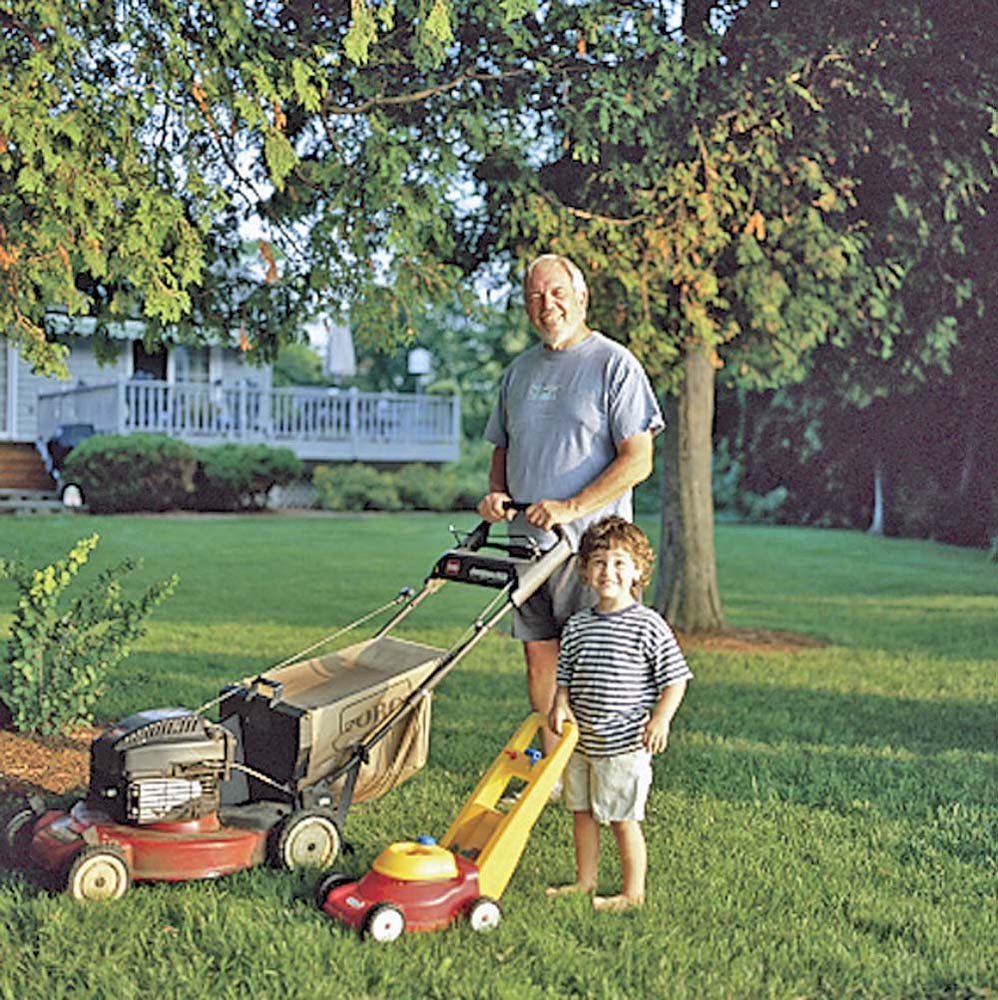
Richard Shasteen and grandson Alex head out for a few hours of work and play.
Photo Credit : Pomerantz, Rich
Read more:Five tips for organic lawn care
Richard Shasteen, retired from a long career as a project manager for IBM, is ferociously proud of the lawn surrounding the home he shares with his wife, Darlene, in Milton, Vermont, on the edge of Lake Champlain.
And he should be: The grass is about as green as green gets, soft as a blanket, with nary a weed in sight.
“We draw our drinking water right from the lake,” Richard says. “We swim in the lake all summer long, too.” A few years ago, Richard and Darlene began to feel uncomfortable with their lawn care practices, which involved service from a national company that treated the grass indiscriminately with pesticides and herbicides promising problem-free growth.
“I hated the way they put signs up on the lawn and told me not to let any children or animals walk on the grass,” says Darlene. “What about the birds and the squirrels?” The Shasteens switched to NaturaLawn of America, a nationally franchised company that provides organic lawn care and integrated pest management, and they couldn’t be happier.
Vermont Public Interest Research Group (VPIRG), a watchdog and advocacy organization in Montpelier, and SafeLawns, a Maine-based nonprofit foundation, are busily spreading the word to homeowners that many of their lawn care practices are doing more harm than good. “The most basic piece of information we’d like to transmit is that lawn chemicals are inherently hazardous,” says Ben Davis, an environmental advocate at VPIRG.
Part of the problem, Davis contends, is that “consumers have been conditioned to purchase a product to solve a problem.” And as any hardware store circular will happily demonstrate, for every lawn care problem there’s a chemical solution: Got grubs? Spread this! Crabgrass? Spread that! The problem with chemically based systems is that those compounds kill earthworms and beneficial insects, too. Lawns need nutrient-rich soil to resist drought, weeds, and pests. Trying to keep a lawn green with synthetic fertilizers is like drinking high-test coffee while skipping the food.
Most of our nation’s 50 million acres of lawn are grown with synthetic fertilizers and pesticides, which are known to pollute soil and water, and to cause health problems in both people and animals, according to SafeLawns, cofounded in 2007 by Paul Tukey, publisher of People, Places & Plants magazine, cohost of the HGTV show by the same name, and author of The Organic Lawn Care Manual (Storey Publishing, 2007, $19.95).
“Americans are spreading millions of tons of toxic materials and wasting enormous amounts of fossil fuels, all in the name of having a beautiful lawn,” says Tukey. “Our mission is to show people that you can have that nice lawn without the toxic and wasteful side effects.” Tukey himself is a former professional landscaper who switched from synthetic to organic methods after becoming ill.
SafeLawns is working to educate society about the benefits of organic lawn care and gardening, with the goal of getting one million acres of turf organic by 2010. The foundation is working nationally to convince schools, colleges, and corporations to eliminate the use of lawn chemicals; to get state and local governments nationwide to follow Connecticut’s lead by adopting laws that prohibit lawn care pesticides on day care center and school grounds; and to urge real estate developers to switch to organic lawn care.
SafeLawns put its claims on display in Washington, D.C., last fall by taking over the care of a fenced-in four-acre area of the National Mall; the fence came down in late March, the grass is lush, and the National Park Service and the Environmental Protection Agency will now begin a two-year evaluation of comparison test plots before deciding whether to expand organic practices to all NPS land.
Richard Shasteen and grandson Alex head out for a few hours of work and play. Photo Credit : Pomerantz, Rich
Americans must redefine their image of the “perfect” lawn, says the man who helped write the nation’s first organic lawn care standards. A healthy lawn that’s weed- and pest-resistant may contain a little clover or moss, says SafeLawns cofounder Todd Harrington, who has owned an organic lawn care business in Connecticut for 20 years. And that’s okay.
Homeowners can have plush, thick, green grass without the chemicals, Tukey adds, and they shouldn’t be fooled into thinking otherwise. “If organic lawn care doesn’t work, Todd Harrington’s doing it with green spray paint,” he quips. “He has more than 1,000 clients, with some of the most beautiful lawns I’ve seen in the world, and he’s doing it organically.”
Professionals need a license to apply some of the same herbicides and pesticides used routinely by homeowners, which is scary for several reasons. For one thing, pesticides suffer from wanderlust; they have a tendency to drift onto other lawns and into waterways. About 98 percent of the weed killer applied to lawns in the U.S. leaks into streams, rivers, lakes, and groundwater. “And a lot of these chemicals don’t break down quickly, particularly if they’re carried inside [on people’s shoes],” adds VPIRG’s Ben Davis. “They may persist in their after-state for months.”
Trace amounts of pesticides were found in the wells of some homeowners who didn’t use chemicals, says a study by Environment and Human Health Inc. (EHHI) of North Haven, Connecticut. “If pesticides are used somewhere in a town, they can end up in someone else’s groundwater,” notes Nancy Alderman, EHHI president.
In addition, pesticides attack native microorganisms and plants, which help keep thatch under control. (Thatch is a mostly undesirable collection of roots and rhizomes between grass and soil that may host insects and disease.) “It’s amazing how Mother Nature has designed this unique food web,” says Harrington, cofounder with Tukey of Safelawns and Landscapes LLC, an organic lawn, tree, and shrub care service. “When it’s in harmony, this orchestra is working collectively.”
In towns around Lake Champlain and throughout New England, the problem is particularly prevalent in the form of phosphorus, a main ingredient in most synthetic lawn fertilizers. The excess finds its way into lakes, where it encourages the growth of blue-green algae blooms, which can be toxic to humans, fish, and pets.
As for Richard and Darlene, they’ll keep treating their lawn naturally. They’re not the only ones to feel the difference. “I notice now, after a couple of summers, that we have frogs, crickets, and toads all over the place,” observes Darlene. “I’d forgotten that these animals are common in the country.” It’s funny what a little nature can bring out.