Coming upon a moose in the wilds of Maine requires that you pass through three stages of comprehension. FIRST STAGE [denial] A moose is very large — larger than you’ve ever imagined. If you’re tall and you ran into a moose, you’d knock your head on its shoulder. You must take a moment or two […]
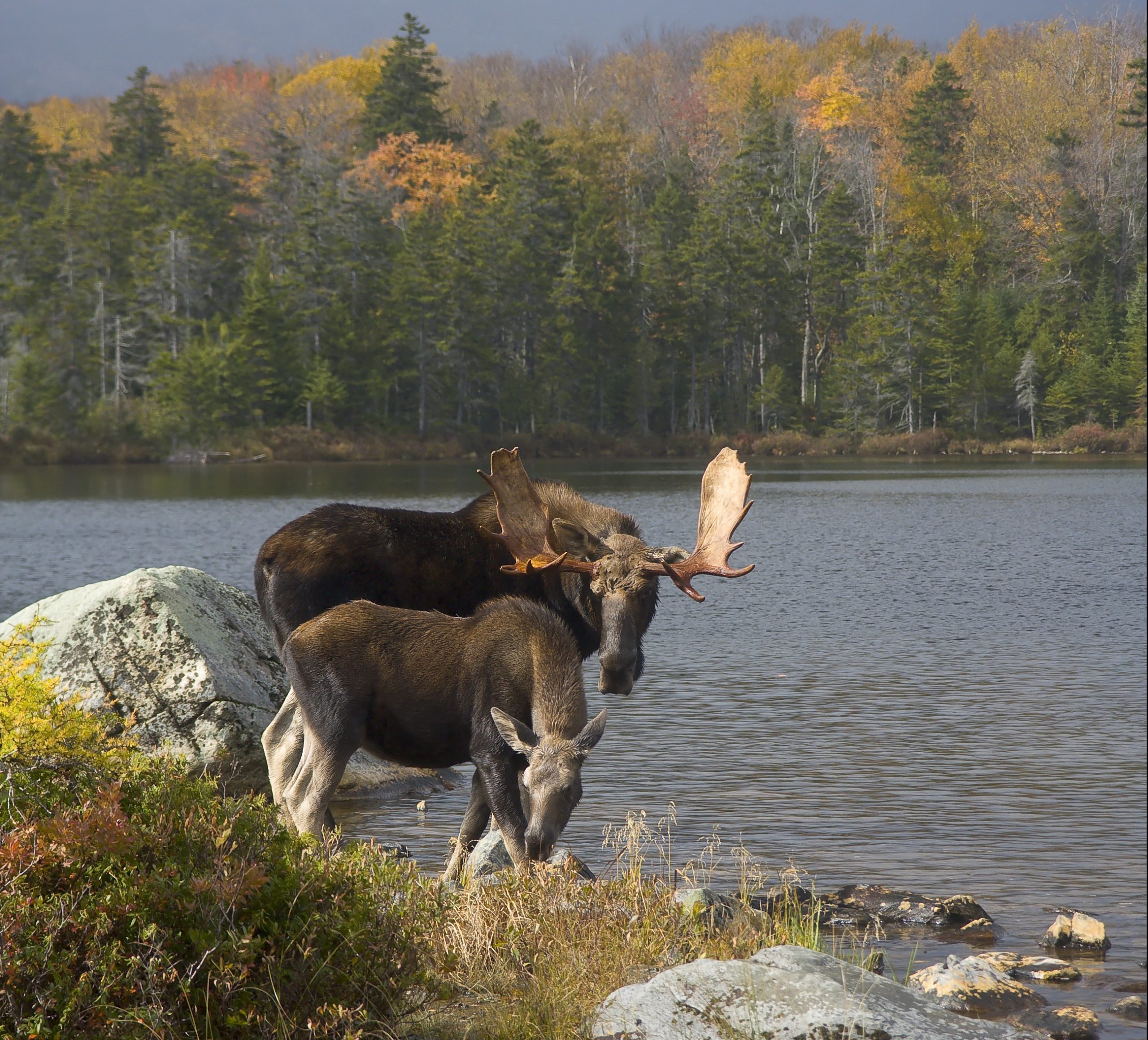
A bull moose and calf at Sandy Stream Pond, Baxter State Park, Maine.
Photo Credit : Richard Seeley
Coming upon a moose in the wilds of Maine requires that you pass through three stages of comprehension.
A bull moose and calf at Sandy Stream Pond, Baxter State Park, Maine. Photo Credit : Richard SeeleyFIRST STAGE [denial]
A moose is very large — larger than you’ve ever imagined. If you’re tall and you ran into a moose, you’d knock your head on its shoulder. You must take a moment or two merely to come to terms with the scale of the moose.
SECOND STAGE [alarm]
See stage one, above. Also, moose are unattractive, with a frighteningly bulbous snout and great gangly legs. (Henry David Thoreau was never more truthful than when he wrote, “The moose is singularly grotesque and awkward to look at.”) However, unlike people we all know, moose aren’t bitter about being unattractive, and they don’t usually channel those feelings into aggressive behavior. Coming upon a moose offers no cause for panic.
THIRD STAGE [accommodation]
Once you register its size and appearance, you start to come to terms with it. This is hard, because you want to compare it to something else: A camel? A bison? Bullwinkle? But all comparisons come up lacking. So you slowly begin to see the moose for what it actually is: the reigning mammal of the North Woods. And that is one of those great moments of New England travel.
How to find that moment? Well, that can be a bit tricky. Moose have the troublesome habit of appearing most when you want to see them least — that is, in your headlight beams, when you’re coasting a little too fast around a wide curve late at night. But moose can be surprisingly elusive when you’re actually looking for them. New Englanders are an enterprising lot, however, and so have founded a small industry to connect moose seekers with their quarry. Moose safaris may be found across the northern reaches of the region, wherever spruce and birch start to dominate over oak and maple. The hottest destination, without doubt, is the town of Greenville, on the southern tip of aptly named Moosehead Lake, Maine’s largest. If moose were automobiles, Greenville would be Detroit.
Greenville is in many ways the de facto capital of the North Woods. It’s where Thoreau launched his canoe a century and a half ago when he set off north up the lake to explore the “moosey, mossy” woods of Maine. Even after all these years, it retains the sensibility of a jumping-off point. And if you know where to go, you can still land in forest nearly as pristine as when Thoreau passed through all those years ago. (Be aware that the great majority of the area is commercial timberland, which is anything but pristine.)
Visitors often find in the North Woods an unfamiliar piece of New England; it takes some time to comprehend, just like the moose. Indeed, even Thoreau found the terrain hereabouts a bit unsettling. (In the end, he decided he preferred the cultivated fields and gentle hills around his Concord, Massachusetts, home.) The forests along the shorelines can be so thick you’re tempted to pull out a flashlight at noon, and forests are often cluttered with the pickup sticks of immature spruce blown down by winter winds — great tangles of spiky twigs that can leave forest explorers with shredded pants and nicked legs. But tucked here and there are tableaus of breathtaking beauty: cloudlike lichen colonies atop granite glacial erratics, and streamsides so lush with verdant mosses you half expect to come upon Hobbits.
And then there are the wetlands. These are the region’s proud souvenirs of the glacial age, where 10,000 years ago melting chunks of ice left bogs and fens and kettleholes — acres of marshy terrain that’s not quite land and not quite water, studded here and there with the bleached skeleton of a spruce and edged with alders. This damp and intricate world, of course, is the moose’s lair. It triggers primeval memories we didn’t know we had. Someone who had never left, say, a concrete house in the Mojave Desert would still step out into this terrain for the first time, sniff the air, and ask, “Where’s the moose?”
A number of options are available to answer that question. Some half-dozen outfitters offer moose safaris, or you can hire an independent Registered Maine Guide to take you out for a day. (A moose tour mixes most agreeably with an afternoon of fishing.) Northwoods Outfitters, for example, located in downtown Greenville, has been guiding moose-watching excursions for more than a decade. You may travel via water or land. On the water, you may find yourself paddling silently in a kayak, and you’ll often hear moose crashing through the alders before you see them. Or take a trip in the encapsulated comfort of a motor vehicle along some of the region’s farflung network of logging roads, keeping an eye peeled for their favorite luncheon grounds.
A handy base for moose watching may be found on the northwest side of Moosehead Lake. The Birches is a classically rustic resort of old log cabins and lazy recreation. Daily tours are offered morning, afternoon, and evening. They’re as close to luxe as you’ll find hereabouts, with guests reposing on the equivalent of vinyl sofas aboard a pontoon boat. You’ll set off up a sea-size lake, then detour up a quiet inlet that turns into an even quieter stream. You may see eagles or mink, and then, as you round a bend … a moose.
The moose is no doubt eating. They do that a lot. Don’t worry — they’re vegetarians. In the summer, they eat some 40 to 50 pounds a day, building heft for the lean days of winter. They often graze along the water’s edge because they especially like the roots of aquatic plants. You may be able to approach reasonably close if your moose has its Oldsmobile-size head underwater, browsing contentedly.
As you gradually arrive at that third stage of comprehension — appreciating the moose in all its mooseyness — notice how it has evolved exquisitely for its habitat. Its great height lets it browse high in branches and deep in the water. The front legs are longer than the rear to help it navigate those tumbled and chaotic woods. The Homer Simpson-like eyes (“Mmmm … aquatic plants!”) give it nearly 360-degree vision, and its superior senses of smell and hearing are thanks to that big snout and the rabbit-like ears.
Ah, yes, and then you hit a fourth stage: realizing you’ve had a quintessential North Woods moment and are now free to return home, uniquely satisfied.
Read about a close encounter with a moose.
More about Maine