Issues → January/February 2009 → Home & Garden →
Budget Flooring: Home Projects
Brown paper bags insulate a drafty floor
by Ian Aldrich
Project: Paper-Finished Flooring
When Gwynne Gardner and her husband, Michael Seitz, decided to turn a back room of their 1793 "honeymoon" Cape in Wilmington, Vermont, into a small guest area, they knew they had their work cut out for them. It was damp. It was drafty. And it had spiders. "The room gave me the creepy-crawlies," says Gwynne.
Much of the problem lay with the pine-plank floor, whose cracks and gaps offered a perfect air channel from the stone-and-earth basement below.
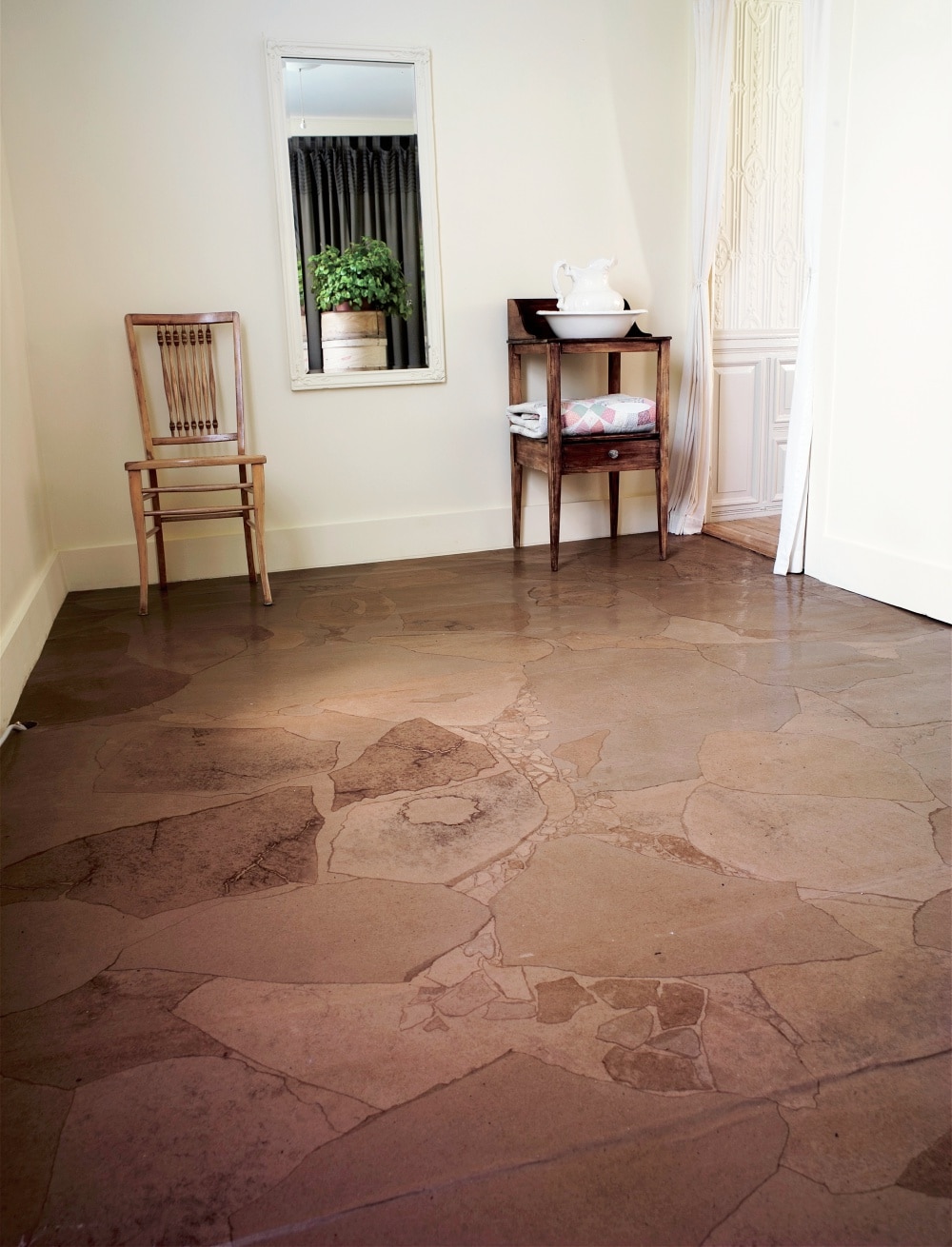
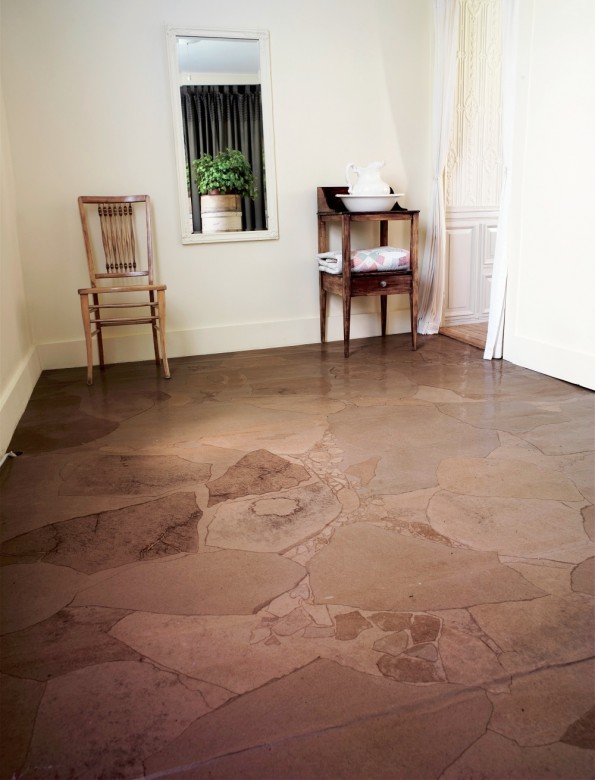
To address both the aesthetics problem and the lack of insulation, Gwynne turned to a technique she'd seen decades ago in a book: using torn pieces of paper bag as a floor finish. The result was a surface with a textured, rocky pattern. Even better: The room's damp, drafty feel quickly vanished.
Process
Gwynne and Michael cleaned the floor thoroughly with soap and hot water, then prepped it, sanding raised spots and packing the gaps between planks with wood filler. Another light sanding followed. Bypassing paper bags for heavier contractor's paper (from a local hardware store), the couple then went at the main part of the work in two stages: bigger pieces first, followed by smaller additions.
Coating the underside of each piece with a 50-50 mix of water and Elmer's white glue, Gwynne placed the larger "stones" strategically on the floorboards, being careful that each piece lay smooth without overlapping any other. Then for protection, Michael used a fine-bristled brush to give the floor a coat of Rust-Oleum's Verathane Diamond Floor Finish, a type of polyurethane.
Gwynne "filled in the holes" with smaller paper pieces--a row of pebble stones here, creative fault lines there--before finishing the whole floor off with four more coats of Varathane. "The nice thing is you can take as long you want," says Gwynne. "Even if you're only partially done, you can still walk on it."
What Do You Like Most?
There's the look and easy care (just mopping), but also the feel. "Walking on it in bare feet," Gwynne says. "It's very soft."
Cost
About $100, including brushes, contractor's paper, glue, and polyurethane
Resource
Rust-Oleum 800-323-3584; rustoleum.com
Stool Top Decorating
Click here for instructions for the stool top decorating project.
More Home Projects?
Have you completed a home project that you'd like to see in Yankee Magazine? We'll pay $100 for every one selected. Write to: editor@YankeeMagazine.com


Reader Comments
Comment from Connie Mcknight on January 4, 2009
I'd like to know if this floor is slick when wet?
Comment from patricia mullins on January 6, 2009
i think it is a beautiful way to finish an old floor. i think i would like to try it.
Comment from Carey Ragels on January 7, 2009
This looks like a very interesting way to treat floors. But I have a question. Could this process be used directly on concrete floors as opposed to wood or plank flooring?
Comment from Samantha Johnson on January 8, 2009
My husband is actually at the hardware store right now buying the supplies to do this project on a concrete floor. I will let you know how this works out. We've been trying to decide what treatment to do in our loft and I just am not a fan of staining concrete and we couldn't afford to do hardwood. This project seems like a great compromise.
Comment from Adriana Hardy on January 13, 2009
Does anyone know if this can be applied directly to concrete floors?
Comment from Gwynne Gardner on January 15, 2009
I covered an old floor in Alaska with this method, although much more simple & plain. Just ripped big pieces, nothing fancy. My daughter & teenage friends were in & out as they all are and the floor held up beautifully. Any time I noticed signs of wear, I simply cleaned the floor, mopped and applied another coat or two of Varathane (about once a year). Voila! Instant gloss! Yes, it can be applied to concrete and most likely anything you can think of. I covered a glue-lam beam in a new home (also in Alaska) with the acrylic paints applied to the paper first. Using irridescent paint, sponges, bird feathers (for fault lines) you can actually mimic mother nature. Folks were constantly asking how we got the rock so thin! HA! The only limitation to this useful and FUN medium is your own imagination. With small painted pieces, I covered a plastic candelabra trio which came out fantastic. My daughter reminded me that I papered a dresser as well. I don't remember that one. Because it is so much fun, I will add a word of caution that came from my daughters: if you paper everything, it is no longer unique! All the best! love, gwynne
Comment from Cathy Barger on January 26, 2009
Hi! I notice in both photographs that the stones are varied shades of brown. Is that because the different pieces of cut out paper stones were painted different colors before they were glued down? Thanks very much!
Comment from Gwynne Gardner on January 27, 2009
Firstly, the "stones" are ripped, never cut. The variety of shades comes from either applying the glue to the topside, or the underside, of the paper (you'll see what I mean as you roll the paper out and tear it - each stone piece will curl from being on the roll. You may glue either side, curl up or curl down, and each side reveals a slightly different shade of brown). Also, the amount of glue applied, and absorbed, causes darker shades of brown. The floor is brown paper only, no acrylics or paint of any kind. When you wish to add color to a project, the method I enjoy is to lay a sheet of plywood across sawhorses as your "table". Roll out a large sheet of contractor's paper, and bring out the paints! Use sea sponges, brushes, (your hands if you like!), feathers for marbling & fractures ... anything at all that will help to create the shades of rocks & stones that always seem to catch your eye in nature. You may use wall acrylics in any color combo, but for the effects found in nature, nothing compares to the variety of iridescent Liquitex Acrylic artist colors. In natural sunlight the iridescents "catch" the light much the same as natural rock does. And these you layer with the other colors and are especially effective as fractures & marbling. All mix with water beautifully so you may use thick bold color or with water you may add more of a wash or anything in between. Just keep sponging, layering, daubing, stroking, shading, feathering, splashing. Remember fingerpainting? When you're satisfied with that particular piece, toss it on the floor to dry, lay out another large piece of paper across your "table", choose a different set of colors and make a new kind of stone. Do at least three separate kinds of stone, just as when you look in a creek you see many different kinds of stone & color. When you're satisfied with your color scheme, start ripping & gluing. It is well worth the extra step & time & did I say FUN!?! Enjoy yourself. Take all the time you need. And step back and admire what you have created. love, gwynne
Comment from Gwynne Gardner on January 27, 2009
Both Michael and I would be happy to answer any questions about your project. Remember, we're describing how "we" do it, but the joy is that each individual finds their own creative expression. So you may take the info and tweek and twirl it into your own version of how "YOU" do it! You may call (802) 464-9641 or email gwynnegardner@yahoo.com
Comment from Dianne Bittermann on January 27, 2009
This is beautiful! You have wonderful artistic talent, Gwynne! I love it! I might try this on an older cabinet that we have once our remodeling is done...thank you for the ideas and instructions!
Comment from Cynthia Farr-Weinfeld on January 27, 2009
What a cool way to re-finish a problem floor! This article was a revelation to me, as we need to remove our wall-to-wall carpeting in our upstairs bedroom due to dust mite allergies and when we checked underneath, we discovered that underneath lies the worst kind of rough subflooring possible. Covering it in this economical, easy way may be just the ticket for this family! Thanks Yankee!
Comment from eleanor rueb on January 27, 2009
How would you remove this finish, if you later want to change the floor ?
Comment from REBECCA KELLEY on January 28, 2009
This sounds like just the project I need for my basement. Approximately what did it cost?
Comment from sally hiler on January 28, 2009
Do you think pre-pasted wallpaper would work on top of vinyl flooring in a bathroom? I was thinking of something like a marble pattern?
Comment from Gwynne Gardner on January 28, 2009
Eleanor: If you later want to change the floor, you may simply apply the new flooring over this paper floor. I wouldn't consider attempting to remove it as there would really be no need. This technique improves an otherwise ordinary, uninteresting, or damaged floor. Paper is an amazing insulator and although it appears to have great texture, it remains smooth and level for new carpeting over it, or new wood flooring, or vinyl ... whatever. Rebecca: Simply find out from your local dealers the cost of a roll of contractor's paper, a gallon of white glue, a gallon of Varathane Diamond Floor Finish (water based). That's your cost! Sally: I have no experience with pre-pasted wallpaper, but I do know that this technique has worked beautifully applied on top of old kitchen tile. I would get some sample pieces and try them out on the floor. I would want to make sure it adheres to the vinyl adequately before I covered the whole floor.
Comment from Gwynne Gardner on January 28, 2009
Would you like to see to what heights others have taken faux effects? (1) Take your time with this particular website. These two Floridians are AMAZING! The ideas that come bubbling up from viewing their work is worth the time you take to click on the links they offer including the "how to's": http://www.trompe-l-oeil-art.com/
(2) Here Bonnye offers most of her trade secrets which, in reality, none of us has! HA! Her techniques can be used "as is" or incorporated into something else that you might create: http://brownbagwalls.com/
(3) Sisters Hands is a consortium of women all across the nation, each with her own "faux" business, and oftentimes joining together in projects for various clients. Its worth it to click on each shadow figure and go to her particular website: http://www.sistershands.com/
Well, if these don't get your juices flowing, I don't know what will! Enjoy! Take your time with your work. I mean really enjoy the process. It will mean so much more to you when you finally say, "It is done."
All the best! Love, Michael & Gwynne
Comment from Judi FitzPatrick on January 28, 2009
This is fantastic, thank you Yankee, Michael, and Gwynne for sharing with us. I have an "asbestos tile over concrete" floor that needs to be changed - maybe I'll give this a try, testing it on my foyer first! Thanks again.
Comment from Lucy & Frank LeBlanc on January 29, 2009
This sounds like a great idea for our cabin floor which is currently "chipboard" painted with three coats of paint, but needing a smoother finish so the dog hair won't get caught in the rough spots. Thanks for all your helpful additional comments!
Comment from Leslie Thompson on January 29, 2009
Judy,
You need to have a professional contractor remove the asbestos tile. It is a #1 health hazard!!
Comment from Mel Allen on February 2, 2009
As Yankee's editor I am so pleased to see the discussion here. We are always on the lookout for home projects going on in New England. especially ones that highligtht that wonderful New England ingenuity. If anyone has a home project, or knows of a neighbor or friend whose project we should know about, be sure to let our "How'd They Do Thatr specialist know. His name is Ian Aldrich. You can reach him at iana@yankeepub.com.
I look forward to seeing your projects in this space--Mel
Comment from Judi FitzPatrick on February 2, 2009
Leslie - Thanks for the "heads up". I plan to put the new floor over the asbestos tiles, then they will be sealed in. Judi
Comment from Coralie Burke on February 16, 2009
I love this flooring option. Yours is beautiful! This sounds like the kind of project that I could really get into. I have a linoleum tile floor that needs to be removed (corners lifting and breaking off at this point) I'm thinking remove the old tiles so we are down to the subfloor. My room has radiant heating in the floor. Will this process work with that?
Comment from Gwynne Gardner on February 17, 2009
Coralie: Absolutely! Once you're down to the sub floor, make sure you've scraped all the glue & such to the degree that the paper will stick securely. I've sometimes prepped a surface to make it even - there are products at hardware stores that will do just that. The one I've used in the past was a powder that mixed with water and applied with a spatula. Nothing fancy and you don't have to go overboard (unless you want to). The point here is that you always want a clean enough surface for a good adhesion. Once you have that, you're ready to go! All the best! love, gwynne
Comment from Gwynne Gardner on February 27, 2009
HOT TIP! Weldbond Glue. All of you DIYers check out their website weldbond.com. Michael and I are currently engaged in an outdoor project using paper, photos & acrylics on fiberglass. Since white glue doesn't hold up well outdoors (especially in Vermont!) we found Weldbond Glue to not only be perfect for this project, but for an incredible variety of applications: as a glue, as a base coat primer, as a clear top coat, as a bonding agent, you name it! love, gwynne
Comment from Susan Bergeron on March 12, 2009
I love this floor.I've been looking for something to use on my three season porch floor. This room is not heated and is the main entrance to the house. It may also on occation, have snow on it. Do you think it would work in this area?
Comment from Gwynne Gardner on March 14, 2009
Susan: I can only tell you that my floor in Alaska sustained a lot of snow, ice, mud & water that came in on everyone's boots. And it held up beautifully with an added coat of Varathane applied each summer. If it were my porch, I would make certain that the wood was completely dry before beginning the project, and, yes, I would paper the floor. I'd use the Weldbond glue as I mentioned in a comment above in lieu of white glue, since Weldbond is waterproof/water resistant. And I would definitely glue down a stone without touching another, then apply a Varathane coat to seal and protect. This I would do for each piece secured to the floor for proper integrity. Think of a checkerboard, white squares and black squares, and apply your first layer of stones as though they were the white squares only, and make sure none of the stones touch one another. Once glued securely and dry, apply a coat of Varathane to each piece, not yet the entire floor, and let it dry overnight. Next day, fill in some of the spaces, again, making certain the new layer of pieces do not touch one another, let dry and coat each piece with Varathane. Continue this process until you reach a point where there are no spots of old floor exposed; all of the old floor has been covered in stone. At this point you may add smaller stones, creek beds, whatever your imagination allows, let dry, coat with Varathane. When you are satisfied with your new floor, in this particular case I would make certain there are no fewer than four coats of Varathane applied to the entire surface at once. Rule of thumb is that Varathane dries in about two hours, so the first day you apply it evenly to the entire surface, wait two hours and apply another coat. Let that dry overnight and apply two more coats the next day or any time thereafter. I would add another coat or two to ensure its stability during the winter. I can tell you that my husband has made a house sign as well as a road sign, completing both with several layers of Varathane. The sign has been hanging in Vermont weather, -30 and such, for many years and still looks as beautiful as day one. The road sign has been up since last summer and looks gorgeous today. I have no reason to believe it will not stand up to the weather as well as our house sign has done! All the best in your special project! love, gwynne
Comment from Susan Bergeron on March 16, 2009
Gwynne:The floor is treated plywood, besides filling the gapes, does the floor have to be sanded? Thank You,Susan
Comment from Gwynne Gardner on March 17, 2009
Susan: Once you fill in the cracks, yes, sanding is the next step. The only thing you're wanting here is to make certain the pieces glue down well. Imperfections will show up in the stones in a very interesting way, so its not important to make it glass, just that each stone should affix in a solid way. We've found with the Weldbond that you can actually fill in the imperfections with a thick coat of it, then apply the stones (with a coat of glue on the back) and put the two together. The Weldbond glue, once completely dry, makes a wonderful impervious adhesion. The floor that is shown on this page suffered a crack alongside a board that moved. The white glue let it separate cleanly, so we simply filled the gap with Weldbond, and created a little creekbed that will continually allow for repair as this ol' house continues to shift and move. Its the beauty of this flooring, any damage is simply no matter. Just apply new stones in a new view, Varathane the entire floor, and presto chango! Another aspect or attribute revealed itself! HA! Have fun! Take your time. Enjoy the process. You'll be glad you did. love, gwynne
Comment from Kim Daggs on May 7, 2009
Can I use this technique on chipboard? Do I need to sand the chipboard? Should I use the white glue as you did or the Weldbond? This seems like a great alternative to the other high cost options out there for flooring. I am so excited to try this and am just a wanting some pointers and tips so that I end up with great results such as yours.Thanks, KIM
Comment from Gwynne Gardner on May 10, 2009
Thanks to all of you who have "figured out" that I seldom check this article anymore. And I love it that so many of you have jumped in to your projects, having so much fun doing so. I don't ignore anyone and welcome your wonderful email inquiries! All the best! love, gwynne
Registered users can add comments.
Registration is free, and just takes a moment.
Login or Register.