




New England Lighthouses | A Lighthouse Life List
We romanticize them, but what makes New England lighthouses quintessential icons is their simple, sturdy practicality. They weren’t built to be the stuff of tourist brochures, postcards, and collectibles. They were built to mark the rocky shore for ships. At the end of the road on the tiny burr of the prickly Maine coast where […]

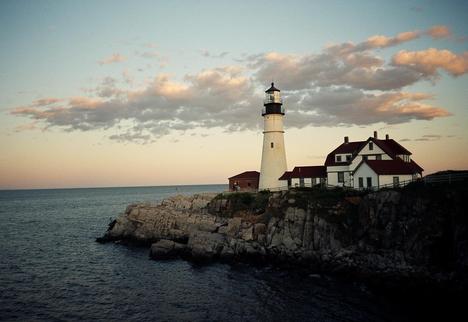
Portland, Maine
Photo Credit : Roxie ZwickerPhoto Credit : Roxie Zwicker
At the end of the road on the tiny burr of the prickly Maine coast where my relatives live is a lighthouse. It’s square and squat and has long been automated, augmented by an ugly modern beacon on a concrete pylon just offshore.
But its light still sweeps the bay, and its lonely foghorn sounds a plaintive, hypnotic wail. Once, while we were walking down the long road to our stubby little lighthouse, my sister and I pondered what made it so special to us. She said it was like knowing that someone’s always waiting up for you, no matter when you come home. Which, of course, is what it’s there for.I confess that I, like marketers and souvenir-shop owners, have profited from the allure of the New England lighthouse. A daily journalist who only halfheartedly accepted an assignment from a publisher to write a book about the lights, I quickly found myself sucked in by stories vastly more dramatic than the ones I was covering in my day-to-day job: stories of terror and tragedy and hardship, heroism and mystery and death.
When it came time to take an author photo for the book’s jacket, however, I chose the humblest of backdrops: I walked to the end of our road in Maine and posed beside our lighthouse. What follows is a tour of some of the most stunning, most romantic, most unusual, even some of the most haunted beacons found anywhere in the world.
MOST SCENIC VIEW At Gay Head Light, on the western end of Martha’s Vineyard, visitors are allowed into the red-brick lantern tower, where they can watch the two lights rotate–and take in extraordinary sunsets over the Aquinnah Cliffs and surf below.
MOST PAINTERLY Maine’s Cape Elizabeth and Portland Head lights were immortalized by the artist Edward Hopper, and Ten Pound Island Light, off Cape Ann, by both Fitz Henry Lane and Winslow Homer.
For me, though, the region’s quintessential lighthouse is Cape Cod’s Nobska Point Light–especially when thousands of runners sweep past it during summer’s annual Falmouth Road Race (August 9 this year). Portland Head also serves as the picturesque finish for a road race: the annual Beach to Beacon (August 1 this year), founded by Olympian and local resident Joan Benoit Samuelson.
In an ironic reversal of artistic tradition, Hopper’s depiction of Maine’s Monhegan Island Light was used as a guide to rebuild the assistant keeper’s cottage, which now houses the Monhegan Museum’s art gallery–perhaps the only museum that not only exhibits works of art but was inspired by one.
KID-FRIENDLY ADVENTURE What kid wouldn’t like tramping up all 69 winding steps to the lantern room at the top of Highland Light in North Truro, 183 feet above the sea off Cape Cod? And checking out the shipwreck room in the neighboring Highland House museum?
RUSTIC OVERNIGHT Provincetown’s Race Point Light is separated from the nearest paved road by two and a half miles of sand dunes–so distant that it’s a Race Point lighthouse keeper who’s credited with inventing the dune buggy. Want to sleep in the keeper’s house? The lantern-light charm has been replaced by solar and wind power, but you’ll still get a sense of the seclusion in which early keepers lived.
LUXURY ACCOMMODATIONS After being deactivated in 1914, Bass River Light in West Dennis, Massachusetts, was converted by a Boston mogul into a summer home. Now it’s a Cape Cod hotel called The Lighthouse Inn, with a private beach, pool, tennis courts, restaurant, ocean views, and working fireplaces–and the only private-family-maintained working lighthouse beacon in the country. Three of the guestrooms are in the original keeper’s house.
Want to own your own keeper’s house? There’s one for sale on Maine’s Isle au Haut. And for a deluxe dinner atop a lighthouse, check out Newburyport’s Rear Range Light.
DESIGNER LIGHTS Some lighthouses carry unexpected architectural pedigrees. Alexander Parris, who designed Boston’s Quincy Market, also designed at least seven lighthouses in Maine, including Mount Desert Rock and Monhegan Island. Castle Hill Light in Newport, Rhode Island, is attributed to H. H. Richardson, famous for Trinity Church in Boston.
The offshore Cleveland East Ledge Light in Buzzards Bay is New England’s only Art Moderne lighthouse, and the last built here (1943). But the oddest? South Portland, Maine’s 13-foot-tall Breakwater (“Bug”) Light is modeled on the fourth-century b.c. Choragic Monument of Lysicrates in Athens, complete with fluted columns.
OFF THE BEATEN PATH Lighthouses were of little use for navigation unless a ship could tell one from another. To set them apart, some were made to blink, others had red lights instead of white, and some had two beams instead of one. There was also one triple light: the original Nauset Light, also called Three Sisters, on Cape Cod. These three identical shingled lighthouses were ultimately deactivated–and moved away. Where are they now? In the last place you’d expect: tucked into a clearing in the Eastham woods, along a marked path called Cable Road, about a third of a mile from the water.
FEEL THE CHILL The keepers of York, Maine’s Boon Island Light often saw the ghost of a sad-faced young woman in white, said to have been either the mistress of the captain of the Nottingham Galley, wrecked in 1710, or the widow of a keeper who died at the lighthouse.
Keepers assigned to Sankaty Head Light on Nantucket’s east coast reported strange events, too, including pots and pans that flew around the kitchen. At Minot’s Ledge Light, located on the storm- and shipwreck-prone Cohasset Rocks of Massachusetts Bay, off Scituate, keepers saw doors open and close by themselves, and heard a tapping on the walls: a signal system once used by Joseph Antoine and Joseph Wilson, assistant keepers killed when the first lighthouse, a spider-like cast-iron tower on piles, was demolished in a storm in 1851. (It was replaced by a sturdy granite-block tower, which took five years to build atop the submerged ledge, but has endured since 1860. )
Keepers at New London Ledge Light in Connecticut swore that the steel door of the tower, which was bolted from the inside, used to open by itself. That’s the door from which keeper John “Ernie” Randolph, in 1936, is said to have jumped to his death after cutting his own throat when he learned his wife had run off with a Block Island ferry captain.
But the most haunted? Seguin Island Light, off the coast of Georgetown and Popham in Maine. In the mid-1800s, one keeper’s wife couldn’t stand living at this desolate station. To appease her, he arranged to buy a player piano. When it arrived, however, there was only one piece of music, and she played it over and over for hours at a time. Driven mad, the keeper strangled his wife and took an axe to the piano. Now witnesses say that at night they can hear a phantom piano playing from the lighthouse.
SAILORS’ SALVATION Some of the villagers of old Provincetown–then called Helltown–would have preferred that no lighthouses had been built there. They made their living salvaging the many shipwrecks, even using false lights on nights with no moon to lure ships to their doom. Since 1872, though, Wood End Light, the third lighthouse built here–with a distinctive 38-foot square brick tower, foghorn, and, perhaps appropriate to its history, a beacon that flashes not white, but red–has guided mariners safely around Provincetown’s southernmost spit of land toward Long Point and the harbor entrance.
IN LONGFELLOW’S TRACKS Henry Wadsworth Longfellow took what he called his weekly “walking constitutionals” to Maine’s Portland Head Light, and it was at this favorite spot that he was inspired to write the foremost lighthouse poem in American literature, called (of course) “The Lighthouse,” published in 1850:
And as the evening darkens, lo! how bright, Through the deep purple of the twilight air, Beams forth the sudden radiance of its light, With strange, unearthly splendor in the glare!
And the great ships sail outward and return Bending and bowing o’er the billowy swells, And ever joyful, as they see it burn, They wave their silent welcomes and farewells.
HOLLYWOOD LIGHTSThe Graves Light in Massachusetts Bay, off the coast of Winthrop, served as one location for David O. Selznick’s 1948 film Portrait of Jennie.Edgartown Light on Martha’s Vineyard was featured in 1975’s Jaws, and Nantucket’s Brant Point Light in the 1996 film To Gillian on Her 37th Birthday. But when Hollywood wanted the archetypal lighthouse to punctuate Tom Hanks’s cross-country run in 1994’s Forrest Gump, they made an Oscar-winning casting choice: Marshall Point Light, Port Clyde, Maine.
SERVICE, WITH AN EARPIECE Look closely: Goat Island Light, which marks dangerous rocks off Cape Porpoise Harbor, east of Kennebunkport, Maine, sometimes serves as an outpost for Secret Service agents guarding the Bush estate at Walker’s Point. It also was the next-to-last full-time-manned lighthouse in the country, before it was finally automated in 1990. Boston Light, though now automated as well, is currently the sole professionally manned lighthouse in the United States.
YES, SHE DID Well before most other occupations opened to them, many women served as lighthouse keepers. The most famous was Idawalley Zorada Lewis, keeper of Lime Rock (now Ida Lewis) Light in Newport Harbor, Rhode Island. When her father had a stroke in 1857, Lewis not only tended the light (and her father) but also rowed her three siblings to school every day. She is credited with rescuing at least 18 people from Newport Harbor during her career, including four boys whose sailboat capsized and three men and the wayward sheep they’d been trying to fish out of the harbor. One of her visitors was President Ulysses S. Grant, in 1869, who landed in ankle-deep water when he got out of his boat. “To see [Ida Lewis], I’d get wet up to my armpits,” he said.
When Lewis died on October 24, 1911, all the vessels anchored in Newport Harbor tolled their bells in her memory; in 1924, the name of the craggy island where she’d lived was changed to Ida Lewis Rock, the only such honor ever paid a lighthouse keeper. The light station itself, since deactivated, is now the Ida Lewis Yacht Club.
HISTORY PLUS A VIEW In the darkest days of the War of 1812, five British warships lined up off the coast of Stonington, Connecticut, and attacked the town. The bombardment is commemorated at the site’s Old Lighthouse Museum inside Stonington Harbor Light.
The vista here is a bonus: From the octagonal tower of this granite lighthouse are views of three states: New York, Rhode Island, and Connecticut.
NATURALLY ICONIC Some lighthouses are now incorporated into parks and nature areas. Wood Island, for example, site of Wood Island Light off Biddeford, Maine, is an Audubon bird sanctuary.
The U.S. Fish and Wildlife Service oversees the area around Monomoy Point Light, on an island south of Chatham on Cape Cod. It’s used by the Cape Cod Museum of Natural History as a nature center, and the land around it is home to more than 300 species of birds.
But the most extraordinary natural lighthouse setting is the 3,335-acre Maine Coastal Islands National Wildlife Refuge, including Two Bush Island Light, outside Penobscot Bay, and Petit Manan Light, farther east in the Gulf of Maine and famous for its colony of puffins and its nesting birds, including Arctic terns.
MOST WIDELY TRAVELED So archetypal is Cape Neddick (“the Nubble”) Light off York Beach, Maine, that a photo of it was launched, along with other artifacts, aboard the Voyager II spacecraft in 1977. But space scientists weren’t the first to recognize the value of its appeal. One entrepreneurial keeper in the early 20th century ferried as many as 300 visitors a day to the lighthouse for 10 cents apiece. For a nickel more, his wife would give them tours. They were fired for neglecting the light.
PIRATE LORE New Hampshire may have only two coastal lighthouses, but one of them is second to none for intrigue. White Island Light, on the approach to Rye and Portsmouth, marks the Isles of Shoals, a forbidding chain of islands where Captain Kidd is thought to have buried some of his treasure. So desolate is this place that one keeper’s son didn’t see a tree till he was 10 years old. When the family visited the mainland, they called it “going to America.”
READ MORE: Lighthouse ToursSLIDE SHOW: LighthousesAll About LighthousesNewburyport Lighthouse Dinner