




Caretaker of the Clock | Here in New England
For almost half a century, Bob Fogg has been Hancock, NH’s man of the hours.

Bob Fogg gazes down at Hancock’s Main Street from his perch amid the clockwork.
Photo Credit : McCabe, JarrodOne summer day in 1965, Bob Fogg was at the Hancock, New Hampshire, town dump when the local fire chief said to him, “Hey, Bob, you’ve got a lot of free time–how’d you like to take care of the town clock?”
“And I didn’t know anything about it,” Fogg says, “but I did know that the clock was stopped at 10 minutes to 6:00. It wasn’t working.”
Fogg and one of the selectmen examined the meetinghouse’s 1872 tower clock and found that a pin had come loose, jamming the gears. They hammered in a new pin, and then they found a packet of old papers that helped them figure out how to run the clock. The strike train–the gears that cause the hammer to hit the big 1820 Revere & Son bell–has to be wound one crank for each hour. It’s a heavy crank, pulling about 500 pounds of weight in a chute that runs 65 feet to the meetinghouse basement. The much lighter time train, which keeps the clock ticking, has to be wound 70 turns a week.
Bob Fogg was 27 years old, and he thought nothing of racing up the steep steps and throwing his weight against the heavy crank that sets the strike hammer. He’d turn a week’s worth–168 cranks–without a pause. On hot days, temperature in the 90s, he’d leave behind a pool of sweat. Now Fogg is 73, though you wouldn’t know it. He’s trim and his face is unlined. He takes his time coming up the stairs, rests before cranking, and breaks up the week’s winding into two or three visits. Even though 20 cranks will leave him winded, he’s fit. He works out at the local gym every weekday at 5:30 a.m. “I can’t even remember back when I was 27, it was so long ago,” he says. “I was a kid then. I could run up the stairs and crank those weights and run back down and not even be breathing hard.”
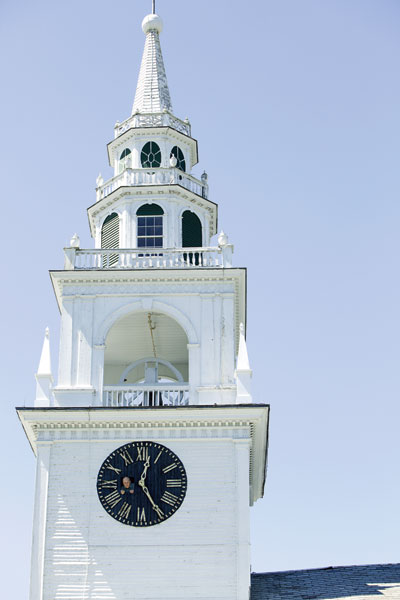
Back then, Fogg knew nothing about clocks; he didn’t even know that anyone had to wind the town clock. He’d grown up spending summers in town, had served in the Navy, and worked in one of the town garages. So he took some adult-education courses at the local middle school; students took clocks apart and cleaned, adjusted, and reassembled them. The tower clock, made by E. Howard & Co. in Roxbury, Massachusetts, has the same parts as other clocks; they’re just larger. Sitting in its own small attic room, the clockworks have the heft of 19th-century industrial machinery. Big gears pull an oversized bicycle chain to move the weights and strike the bell, while smaller gears (or “wheels”) keep the time with a gentle tick-tock. It’s a combination of brute force and perfect balance, like watching a 300-pound ballerina twirling a pirouette in Swan Lake. And it doesn’t take much to stop it. Fogg can lay his finger on part of the escapement–the small wheel that beats out the tick-tock–and all three clockfaces, each six feet in diameter, will stop. (There’s no clockface on the back of the tower, above Norway Plain Cemetery. “To those people, time means nothing,” Fogg says.)
Up in the tower, the clock’s ticking is reassuring. It’s authoritative. It imposes order. You’d never think of doubting it, as you might the measly digital numbers blinking at us from so many household appliances. It’s almost enough to make you a believer in the “clockwork universe,” the cosmos as a perfect machine.
“It keeps very, very good time,” Fogg notes. You can set your watch by it–and all three faces are in sync: “When the clock strikes, I’ll look at my watch.” He wears a big wristwatch: “This is an atomic watch. It’s right to the second. My wife told me I ought to have this because that way I keep the clock right. If I’m home and I hear it strike, I’ll look at my watch and say, ‘Yep, it’s right on.'”
As “Agent for the Town Clock” (his official title, for which he’s paid about $700 a year), Fogg has seen the clock through some tough times: stuck weights, a bent shaft, a disabled clock arm. On two occasions, the strike hammer had broken because someone was ringing the bell on the hour. When that happens, the 1,100-pound bell smashes into the 40-pound hammer. The bell has to be sitting still on the hour when the hammer strikes; otherwise Fogg will find a broken hammer lying on the belfry floor.
The first time that happened, “I was kind of a rookie,” he says, just five years on the job. When he realized that the clock’s strike hammer was broken, he figured there was no reason to keep winding the strike train. He gave it a rest; the weights descended in the chute all the way to the basement. With the hammer fixed, he began cranking the heavy weights.
“When I started to wind it, I said, ‘Wow, this is working hard.’ I thought, ‘Well, it’s because the weights are all the way down and I have to wind up the weights plus the chain.’ So I’m cranking away and all of a sudden, bang! I hear this loud crack. A big timber that holds one of the pulleys had snapped right off.”
The weights had jammed. The tension had built up; a big half-inch-thick, S-shaped steel hook had stretched almost straight before letting go; the timber cracked and the chain went flying. “It took me about three months to get all of that straightened out,” Fogg recalls.
Another time, the clock was stopping at 25 minutes to the hour. “Just randomly. Not every hour,” he recalls. “And I’m thinking, ‘What the heck is making the clock stop?'” He’d reset it and “the clock might work for a day. Might work for five hours. Might work for two days. All of a sudden the clock would stop at 25 minutes to the hour. I spent two or three weeks coming down here, looking at everything, checking everything. What is doing this?”
He finally found the problem: On the east face, there was one loose screw on Roman numeral VII. Sometimes the minute hand would slip past that one screw; sometimes it caught it. That’s all it took to stop the clock. Fogg opened a small door in the clockface, leaned way out, and removed that screw.
But for almost half a century, maintaining Hancock’s clock has been mostly just a matter of being faithful and attentive. Fogg delicately adjusts the pendulum to compenstate for the weather, because metals expand and contract with the temperature. In the winter, when the metal contracts, the clock speeds up a little, so he adjusts the pendulum ever so slightly.
The crank handle to set the strike train is worn shiny in one spot, a groove. Every time the crank comes around, it rubs against the bell rope, so that in 140 years the hemp has polished a little valley in the steel shaft. Bob Fogg accounts for a third of that wear. Add it up: He’s been winding the clock a little more than 46 years. That’s 2,400 weeks, 168 cranks a week … and Fogg has pushed that heavy crank through more than 403,000 revolutions. Then add to that more than 168,000 turns to keep the time train ticking.
Constancy, routine–Fogg has wound the clock through wars, assassinations, moon landings, riots, a presidential impeachment, inflation, stagflation, recessions, the Cold War, terrorist attacks, and all the rest. But it’s not a stifling routine; it’s a devotion. We count on people like him to keep all the other works in town running: the folks who organize the yearly town meetings and reports and parades, the committees who attend to necessary repairs and improvements, those who surprise us by showing us the grace of the ordinary. A quick check of Hancock’s town report shows more than 125 different people volunteering for town offices and committees to keep this community of 1,650 going.
Bob Fogg comes from people who believed in community service, but they never used those words at all. It’s just what they did; they pitched in and helped out. His great-great-uncle helped raise the money to buy the clock in 1872. When the town needed a water system, his grandfather helped see to that, and when electricity arrived, he helped with that, too. His grandfather also ran the general store from 1896 to 1926. His grandmother taught school in town. An aunt was the first “woman selectman” in Hancock (in the Dark Ages, the 1950s).
“His grandfather just had a little bit to do with everything that was going on, and everybody knew him and trusted him. Bob is like that,” a neighbor says. He leads field trips to see the bell, coaches sports, dresses up as the Easter Bunny, makes cookies for a fundraiser in town–it’s a very long list. It’s just that he’s always around, doing something for the town. He doesn’t say anything about it. If it needs to be done, he does it. He doesn’t have a grand plan or any ulterior motives. He won’t tell you any of this, either. He doesn’t smother you in ancestor talk. He keeps the clock going, just as his ancestors helped keep the town going.
“I do it because I take pride in living in Hancock and seeing the clock work,” Fogg says. “In all the years I’ve been winding the clock, the only other one who’s ever wound it is my son. When I started doing this, Bobby was about 4 or 5 years old. He used to come up with me; you know how kids follow their dads.
“Well, Bobby used to say to me, ‘Dad, when you retire, when you give up this job, I’ll take it over.’ And I said, ‘Well, maybe, but I have to tell the selectmen because they have to appoint you. I can’t just give you this job.’ ‘So,’ Bobby said, ‘you put in a good word for me.'”
